



Memory & Photography
Martin Källström's deepest recurring subject isn't cameras — it's memory itself: how fast it fades, what it would take to engineer around that, and, a decade later, what it means to hand the job of remembering to a machine. Narrative (born Memoto) was his first serious attempt at a fix: a wearable camera built to manufacture a "photographic memory" no human brain could match on its own. That project's presence-over-performance philosophy has its own page at Presence & Attention, and its privacy-by-design architecture at Privacy & Surveillance. This page follows the thread that connects the camera years to the present: the claim, repeated in one form or another for over a decade, that human memory is unreliable in specific, describable ways — and that the fix, first a clip-on camera and later an AI system, has to be engineered around exactly how memory actually fails.
Human memory is not built to last
Martin's own case for why this matters starts with loss — he lost his father at 22 and his mother about a decade later, grief that gets its full telling on Father's death and Mother's death — and what stayed with him afterward wasn't the loss itself but how fast the memory of ordinary time together dissolved. He generalizes this into a claim about memory's actual timeline: memories fade far more quickly than intuition suggests — within years, not decades, even emotionally significant experiences become inaccessible without a visual anchor ▶ 18:11. Decades later, talking about AI rather than cameras, he makes almost the identical point about the present tense: "we're not really good at remembering things. And as soon as you just use something for a few days, it starts to add in details that you completely forgot, although it was just yesterday." ▶ 19:04 The mechanism changed — camera, then AI — but the diagnosis of the underlying problem never did.
The dream of a photographic memory
The premise Memoto marketed on was blunt: what if you could relive any moment of your life? The Verge ↗ quoted Källström's own version of the pitch — "with Memoto, you can effortlessly travel back in time to that moment when you met the love of your life, the day your daughter took her first step, or that night you laughed the night away with friends" — a promise he elsewhere called simply "the dream of a photographic memory." HuffPost ↗
The machinery behind the memory
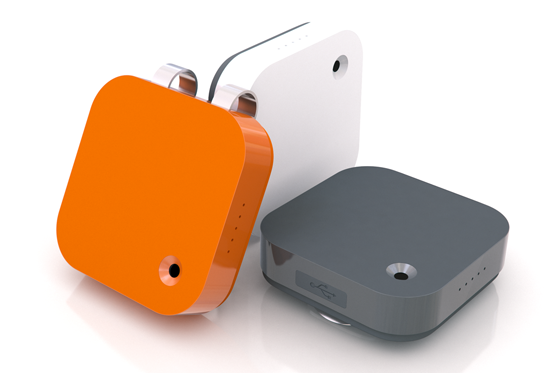
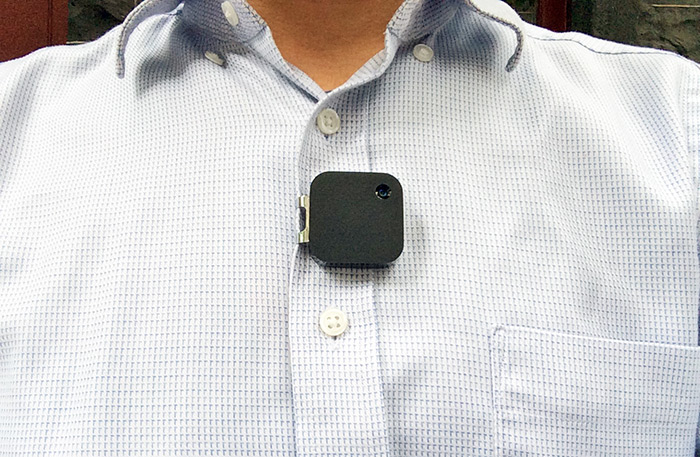
Making that dream mechanical meant a string of decisions that had less to do with photography as a craft than with photography as data engineering (full hardware specs live on Narrative). The camera itself just fired at a fixed interval, so nearly the entire "memory" problem got pushed downstream into software: Memoto's app clustered a day's raw output into roughly 30 keyframes, tap-to-relive as a stop-motion sequence of one moment Kickstarter ↗; Narrative's later cloud service went further, sorting images by GPS, time, orientation, lighting, color, composition, blur, and detected faces SlashGear ↗, in what one reviewer called the real innovation — not the hardware at all, but "its work on contextual processing," making sense of an otherwise unmanageable flood of personal data SlashGear ↗.
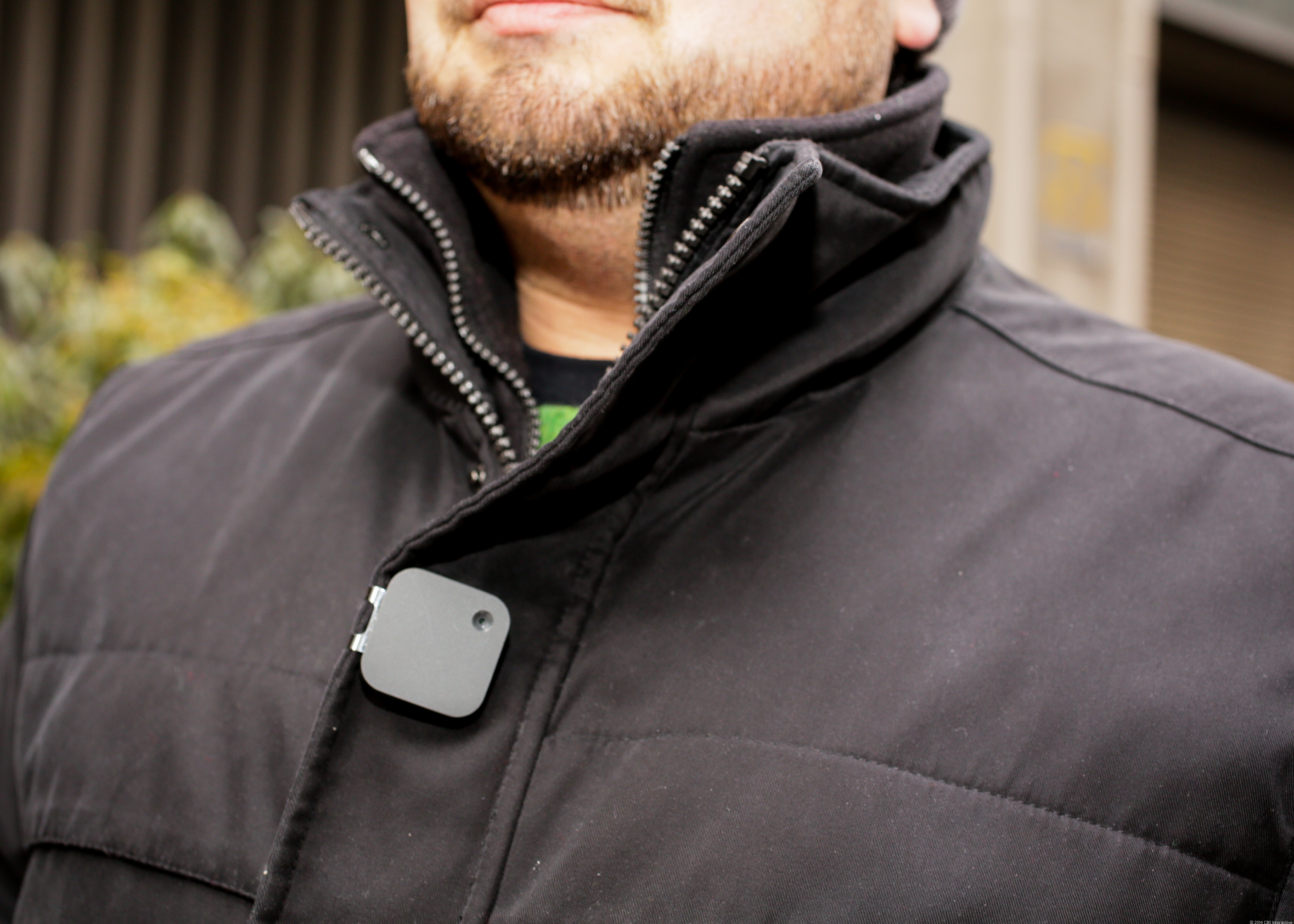
None of it worked cleanly. The moments-selection algorithm was, by its own reviewers' account, "a bit hit and miss" iStartedSomething ↗; because the camera's aim depended entirely on how it happened to rest once clipped to a shirt, "where that little camera is really looking, well, that's anyone's guess" CNET ↗; and its 70-degree field of view captured barely half of what a human eye actually sees iStartedSomething ↗. A peer-reviewed study tested the premise itself and came back with a quietly damning result for a device whose whole reason for existing was recall: automated Narrative Clip capture produced far more pictures than manual photography, but it did not actually help people remember the experience any better study ↗.
Memory becomes a design problem for AI
By the time Källström is talking about AI rather than cameras, the vocabulary has shifted but the question hasn't: what does it take to remember well? His clearest statement of continuity is that human memory quietly fabricates detail even while it feels reliable, which is exactly why "everyday photo-logging of one's own life holds AI-assistant value that remains almost entirely unexplored." ▶ 19:55 He goes further, reframing the Narrative Clip's own history in hindsight: the hardware, he argues, existed a full decade before the AI needed to make sense of it did — "we launched Narrative Clip 10 years too early... it would be really nice to just do a trial on what happens if GPT-4 would get a whole day of photos to go through to learn about your preferences and how you spend your day." ▶ 16:21 That's not nostalgia; he's floated using the Clip's own archive as a literal AI training asset ▶ 16:39, and separately wants ubiquitous ambient sensing of his own daily life specifically so an AI "can learn from my everyday life and be just much more clued in on what's going on with me." ▶ 26:54 (The Clip's dormant IP as an actual revival candidate is its own story on Narrative.)
Pushed further, in a 2024 conversation devoted entirely to how AI should remember, Källström treats memory as close to the whole architecture of mind. Memory, in his framing, isn't one feature among many but "the fundamental basis for learning, for communication, for relationships" ▶ 1:46 — and he locates artificial consciousness itself there too: an internal state that carries forward across interactions, combining short-term context with long-term memory and reflection ▶ 3:56. Not all memory should count equally, in his view — some of it is foundational, cascading across a whole network of associations the way a single fact like "Martin has cats, Martin likes cats" reveals more about a person than most single conversations could ▶ 13:26 — and he argues AI actually has a structural edge over human memory here: it can hold more of it, and hold it unchanged, without the emotional reconsolidation that quietly edits human memories every time they're recalled ▶ 19:31. His proposed fix keeps a foot in both camps rather than picking one: AI should still "reflect on the memory in some ways, maybe adjust it a bit" each time it's recalled — deliberately mimicking human reconsolidation instead of freezing memory into static, inert storage ▶ 18:15.
The oldest version of this argument he traces back further than any camera or model. He theorizes that early nature religions were themselves a memory technology — a way of encoding survival knowledge, which plants and animals could feed you and which could kill you, by "forming social relationships to those plants, basically anthropomorphizing them, or even thinking that there is a deity living in this tree." ▶ 30:52 Brains, on his account, evolved for social memory first, so wrapping information in a relationship made it stick — "we actually have a lot stronger memories... if we connect them to relationships." ▶ 30:27 Cameras, and now AI, are in his telling just the latest attempt at the same trick.
Lifelogging, not surveillance
One distinction Källström returns to across a decade of interviews: recording your own life is categorically different from watching someone else's. The Lifeloggers documentary states the line he keeps drawing in practice — surveillance observes from above, while lifelogging captures "from the perspective of the self." ▶ 19:59 The design mechanics that follow from that distinction — the camera's honesty, its default privacy, the legal gray zones it ran into — are their own subject on Privacy & Surveillance.
Worth remembering
- Memoto's roots were in the Quantified Self movement, but Källström was explicit about the departure: "it absolutely has part of its roots in the domain of analyzing numbers... but what we want to do is to humanize this lifelogging activity and make it more about emotions and memories and people." ▶ 5:01
- Explaining why he cares about capturing the present in real time, Källström once reached for Blade Runner's dying replicant Roy Batty — whose grief at the imminent loss of his own memories, Källström argued, is exactly the feeling a camera like Memoto is built to answer ▶ 13:42.
- After Narrative's 2016 bankruptcy, CTO Björn Wesén argued the underlying idea hadn't actually failed — lifelogging might look "antiquated," but he believed "there's potentially a large market that might still want to document their daily lives" Engadget ↗, a belief the bankruptcy story bears out: the IP survived, and Källström still floats reviving it for the AI era.