
Old fears, new machines
When Martin is asked to explain a new technology that people are frightened of, he rarely argues about the technology. He reaches for a story from before it existed. In 2010 it was Martin Luther and the printing press, against the panic that the social web was ruining our attention. In 2013 it was the Sony Walkman, against the claim that nobody would wear a camera. In 2024 it was an Icelandic grandmother who refused to answer a telephone, against the dread of deepfakes, and a university course he took in 1998, against the idea that AI agents were new. The reflex runs through Twingly, Narrative and the Co-creating with AI podcast alike, and it is a method: find the earlier version of the fear, show what happened, then ask what is genuinely different this time.
Luther's monks (2010)
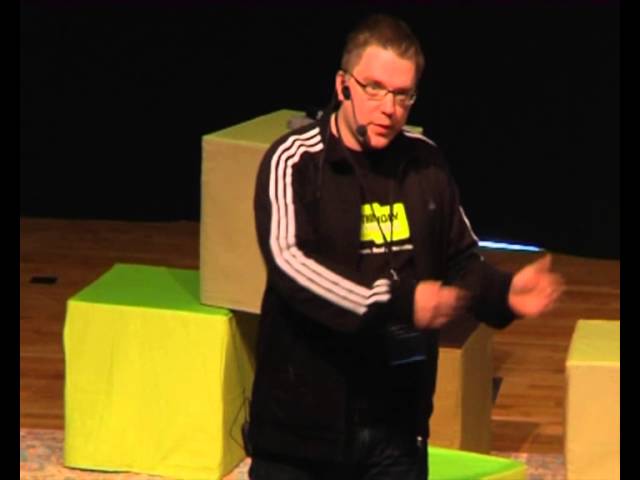
The first recorded instance is a talk at Moving Images in 2010, where the audience had just voted on which of four topics the Twingly CEO should improvise on. Martin walked through Nicholas Carr's worry that the web erodes deep reading, in Carr's terms: "det djupa tänkandet, det som Ellen Key efterfrågade, som är väldigt viktigt, det håller på att försvinna" (deep thinking, the kind Ellen Key called for, which is very important, is disappearing). ▶ 11:58 Then he put the opposite book on the screen, Steven Johnson's Everything Bad Is Good for You, and paraphrased it with equal fairness: "Allt som händer i dagens mediekultur gör oss smartare, mer visuellt tänkande, mer deltagande och mycket mer aktiva och sociala människor." (everything happening in today's media culture makes us smarter, more visual thinkers, more participatory and much more active and social people). ▶ 12:24
Then came the move that became his signature. "Den här rädslan som vi ser idag över att vår mediekonsumtion förändras, den är inte på något sätt ny. Det här är ett citat av Martin Luther." (This fear we see today about our media consumption changing is in no way new. This is a quote from Martin Luther.) ▶ 13:42 Before print, "Det fanns ingen i allmänheten som kunde skriva böcker och läsa dem, utan det var munkarnas jobb" (nobody among the general public could write and read books; that was the monks' job), and the press was a revolution that produced the school we still have: "Den revolutionen ledde till den formen av skola vi har idag." ▶ 14:34 The sting was in what followed. Concentration is prized today because "man behöver koncentrera sig för att kunna komma igenom en hel bok" (you need to concentrate to get through a whole book), which makes the virtue itself a by-product of a 16th-century technology. ▶ 14:34
Wires out of your head (2013)
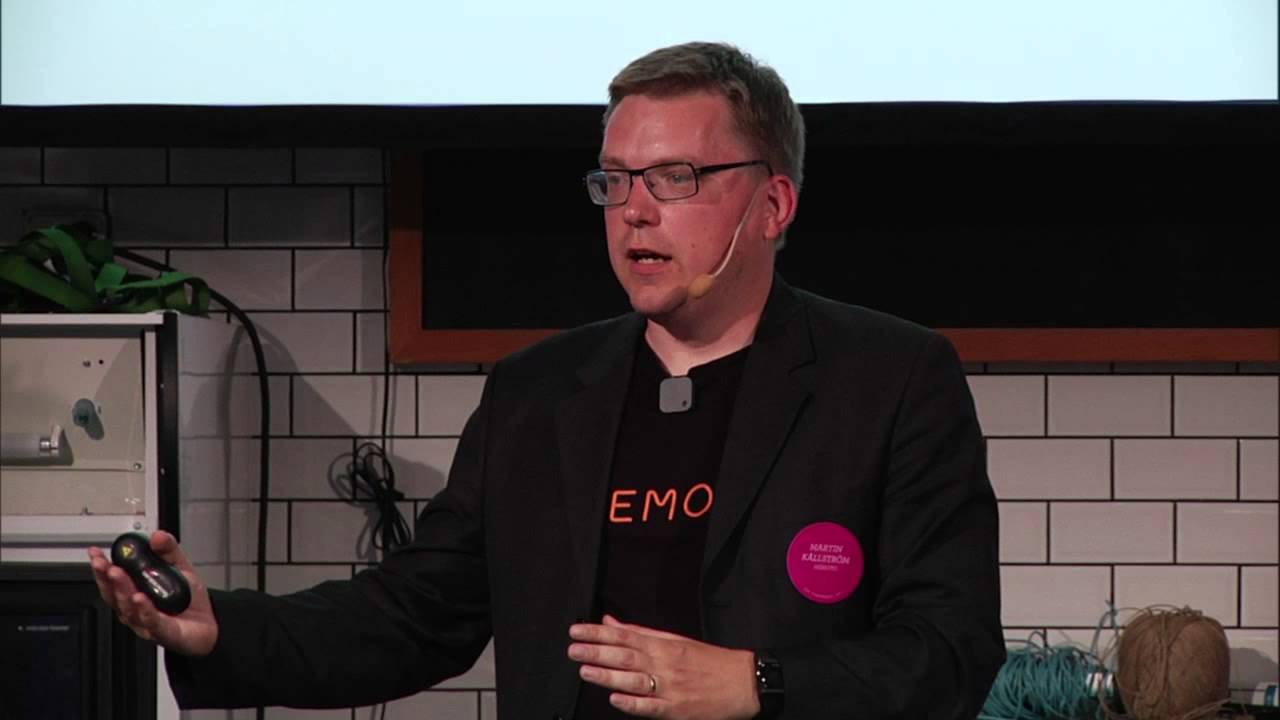
Three years later the fear had changed shape and so had Martin's company. Presenting the Memoto camera at The Conference in 2013, he framed the field's problem as form factor: "the major challenge for wearable technology is to find new form factors of how we can wear technology that is not too much in your face". ▶ 2:08 His precedent was the Walkman. "There was huge resistance inside Sony to the idea that you would actually wear plugs into your ears with wires going out of your head." One engineer pushed; the rest of the organisation said "No one will ever look like a jerk or an idiot with wires sticking out of their heads." Sony took the chance, and most of the room, Martin noted, now owned five pairs. ▶ 2:35 The parallel did not dissolve the social friction of a chest-worn camera; the Narrative story shows how much remained. But it reframed the objection from 'people won't' to 'people haven't yet', the only frame in which a hardware startup can operate.
The grandmother and the telephone (2024)
The clearest recent example came in a February 2024 episode about AI advertising at the Super Bowl. Martin first stated the law he has come to believe: "AI is a perfect example of a technology where we overestimate the short-term impact and we underestimate the long-term impact." ▶ 13:01 Then he told a story from a friend in Iceland whose grandmother, in a remote house, refused to take calls on her newly installed telephone. Her reasoning: "how can I trust what someone is saying in a machine? Like, this is not a person talking. I hear a voice and it even sounds like you. So if it can imitate your voice, then it can make you say anything. How would I ever trust that?" ▶ 14:59 Rasmus Adler Wahlberg, his co-host, called it astute. Martin's closing line was the point: "that was just a normal phone and it was probably like 50 years ago. And now those concerns are coming real with the next wave of technology." ▶ 14:47
The story does not say the fear is silly; the same episode goes on to a $25 million deepfake fraud and a spoof-email attack on Narrative (see Failure & resilience). It says the fear is old, a society once learned to live with it, and the protocols it built then are the place to start. Rasmus added the Gartner-shaped version: the hopes and fears shrink until "now all of a sudden they're more realistic". ▶ 16:20
The course he took in 1998
The parallel Martin draws most often is to his own education. Discussing his daughter's start on a computer science degree, he recalled: "we were taught about agent technology. This was in 1998. I'm that old." Nobody outside the university used it, "there were no books about it. And it's not until now, 20, 25 years later, that it's actually one of the biggest things in the tech industry". ▶ 20:59 ▶ 21:25 He returned to it when multi-agent frameworks became the frontier topic: "when I was in, in the university in, in the '90s, '94 to '99, then we, we had a course in agent frameworks. Like agents talking to agents." The textbook example was agents negotiating prices, which is "what has been going on for a couple of decades inside Google Ads ad engine". ▶ 21:40 ▶ 36:03 The parallel is not there to deflate the field. It locates the actual gap: nobody had built "my proactive agent AI talking to your proactive agent AI", transparently, in natural language. ▶ 20:51
When custom GPTs arrived he heard another decade: "I remember 15 years ago during the Web 2.0, we had this concept of mashups." A GPT stitched from existing services is the mashup startup reborn. ▶ 24:25
ReadSoft, or the parallel as a business plan
Sometimes the old story is a go-to-market template. Asked how AI would reshape professional services, Martin went back to 2001, when he did web development in Japan for the Swedish trading house Gadelius. ▶ 6:06 A Danish machine-learning company, ReadSoft, came through with software that read scanned forms; "This is like 24 years ago". ▶ 6:32 Its first customers were the form-scanning bureaus it threatened: "they did first was to sell to all of those form scanning companies so they could continue their business, but basically fire a big portion of their staff because they could do it by machine instead". Once it had all of them, it sold to the bureaus' customers directly. ▶ 5:57 By the end, "they had sold like 1.6 times the full market value because they first sold to the suppliers and then sold to supplier customers". ▶ 7:59 It is the concrete answer to Rasmus's Bezos-flavoured "your margin is my opportunity" ▶ 5:14, and it ends with Martin's question: "AI is very glamorous. When do we see the first wave of unglamorous AI companies?" ▶ 32:37
What the reflex is for
It is a shared habit on the podcast; Rasmus reaches for Excel ("the trend ever since the computer came has been for us to automate, to delegate all the stuff we don't want to do") ▶ 2:09 and for the Luddites, "the English workers in the beginning of the 1800s that started destroying machinery". ▶ 18:37 But Martin's parallels are usually something he lived through or was told directly, and they cut both ways: in 2012 he used his own grandmother, "really, really angry at TV4. for putting recipes on the web instead of text TV", to argue that the fear of being left behind is as real as the fear of the machine. ▶ 10:16
The method's own summary came at the end of a conversation with the database veteran Malcolm Sparks: "how everything we do exists in the context from what came before, that how much is informed consciously or subconsciously about what, what we've experienced in technology of the past." ▶ 46:39 For the vocabulary he built on this habit, see Work is machine simulation; for what happens when the parallel is a marketing video rather than a memory, see Clone the repo before you believe the demo.
Worth remembering
- The fear of a new medium is never new: the printing press terrified people too, and produced the school system that now prizes concentration. ▶ 13:42 ▶ 14:34
- 'Nobody will wear that' has been wrong before; Sony's own engineers said it about earbuds. ▶ 2:35
- A grandmother distrusted the telephone for exactly the reason we now distrust deepfakes; start from the protocols society built then. ▶ 14:47
- Agents talking to agents was a university course in 1998; the new part is making them talk transparently on our behalf. ▶ 20:59 ▶ 20:51
- The best parallels are also plans: ReadSoft sold to the incumbents first and ended up selling 1.6 times the market. ▶ 7:59