


Twingly
Blog search and social-data company Martin Källström co-founded in Linköping in 2006 and led as CEO until 2012, when he stepped away to found what became Narrative.
Compiled from 51 sources · 316 facts · 10 stories · every claim links to its exact source moment.
Origins
Twingly began life as Primelabs, a project four Linköping technicians — Martin Källström, Niklas, Björn and Figge — started around 2006 ▶ 0:44, renamed Twingly in April 2008 once the blog-search product had eclipsed everything else the company did ▶ 1:10. The founders weren't chasing blogs to start with.
Pivoting from Blocket clone to global blog search. Martin describes how they had nearly completed a Blocket-like classifieds service, planning to replicate a US model locally. When blogging exploded in 2006—driven by coverage of elections like they had seen in the US—they recognized a larger opportunity. They abandoned the near-finished project and pivoted entirely to building a global blog search engine, leveraging technical foundations (language handling, geographic ambition) from the failed attempt. ▶ 4:04
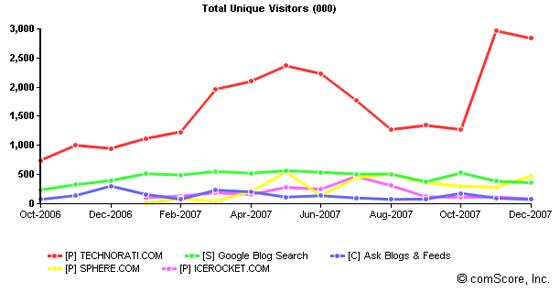
The pivot worked because it landed on a specific, well-timed bet: Twingly built a search engine using pingbacks from blogs to create an index of blog links ▶ 14:35, and set out to be a spam-free, European-first alternative to Technorati and Google Blog Search rather than a bigger, noisier index TechCrunch ↗. By April 2008 the young company had grown from four founders to nine people ▶ 3:18; Anton, later the product manager behind one of Twingly's most instructive failures (below), was its first hire, the fifth person in the building ▶ 8:32.
Its first customers, signed in 2006, were Sweden's two biggest newspapers — and the story of how they actually launched is less tidy than the press release version.
The Newspaper Race. Asked for the key to Twingly's early success, Martin offers to tell 'the sanitized version and the true version' — and picks the true one. Dagens Nyheter signed first but dragged its feet on launch; meanwhile Svenska Dagbladet's tech lead let slip that something was coming. DN saw that and rushed a test version live; SvD saw DN's move and launched the same day. Neither newspaper had wanted to be second, and both ended up furious with Twingly for a coincidence Twingly hadn't engineered — even though, as a young company, they didn't yet know it was practically forbidden to supply a shared product to both a Bonnier and a Schibsted title. ▶ 19:33
Products
Blog Search & the newspaper widget
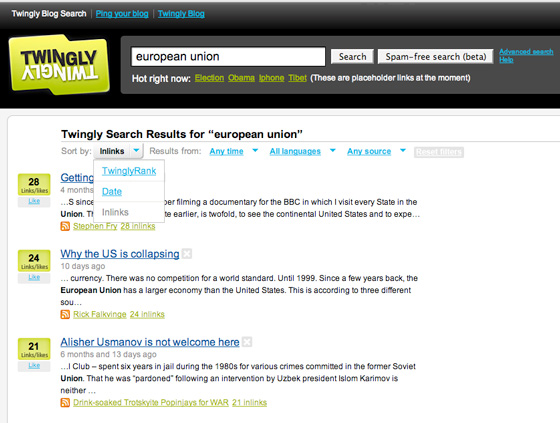
Twingly Blog Search indexed the world's blogs and let readers, and later newspapers, search and follow them. At its June 2008 international launch the index covered 30 million blogs Teknikfreak ↗ TechCrunch ↗ in 29 live languages with another 31 tracked but undeployed TechCrunch ↗, ranked by a proprietary algorithm — TwinglyRank — that combined keyword relevance, inbound links, user votes and freshness TechCrunch ↗. Spam control was the product's real differentiator: rather than crawl the whole web, Twingly built a hand-curated whitelist of roughly 6,000 known-quality blogs and grew it algorithmically by following their outbound links, on the assumption that real bloggers don't link to spam TechCrunch ↗ ▶ 1:24:01. By the June 2008 launch the whitelist held 450,000 approved blogs and was adding 1,000 more a day TechCrunch ↗. Its own launch materials didn't undersell the ambition, either: 'nothing short of world dominance' The Next Web ↗. Readers could vote on posts to influence ranking, subscribe to results by RSS or email alert, translate and filter by language, and embed any of it via widgets TechCrunch ↗; gHacks called the result cleaner and more usable than either Google Blog Search or Technorati gHacks ↗.
The commercial engine underneath was the newspaper widget — later branded Blogstream — which showed a newspaper's readers which bloggers were writing about a given article, and showed those bloggers a link back. Twingly built the traffic-sharing relationship with Dagens Nyheter and Svenska Dagbladet before it had a public search engine at all Teknikfreak ↗, then spent over a year building the same relationship with 50 more newspapers across Europe: La Vanguardia, Público, De Telegraaf, Politiken, Helsingin Sanomat, Dagbladet and others Teknikfreak ↗. Papers that ran it saw roughly a 200% increase in blog links to their articles ▶ 2:42; Martin described the arrangement as strictly symbiotic — SEO and traffic for the newspaper, real readership for the blogger ▶ 4:23 — and by 2008 Twingly was, for the first time, helping a paper earn money from content instead of billing it for a service ▶ 1:29. By 2010 the same core technology, unchanged since the DN/SvD launch three years earlier, was running the combined traffic of 115 customers ▶ 6:24, and by November 2011 Twingly counted 139 partners in 15 countries Björn Rutgersson ↗.
Channels, Live & Microblog Search
Twingly Channels (2009–2010) inverted the follow model of Twitter and Facebook: instead of following people, users followed topics, in channels anyone could set up and invite others into ▶ 2:21 ▶ 0:15. It was pitched as a cure for information overload — a way to monitor a subject across the fragmented social web without wading through all of it ▶ 0:23 — aggregating Twingly's own blog and microblog indexes alongside Digg, Delicious, Flickr, WordPress.com and Blogspot Anders Thoresson ↗, with an API and iPhone/desktop apps planned once it opened to the public for free in 2010 ▶ 3:03 ▶ 5:22. One early commercial use: a Vattenfall-sponsored Twingly Live stream on dn.se covering the Copenhagen climate conference ▶ 1:04. Martin was blunt about why real-time mattered commercially: Google's own move into real-time search in 2009 wasn't a threat but validation of a niche Twingly had bet on years earlier ▶ 3:35 ▶ 4:00.
Twingly Live, the real-time companion product, ran alongside broadcasts and events using long-polling — 'a set of hacks' tuned per browser to fake persistent connections before WebSockets existed ▶ 12:00 ▶ 42:36. It handled roughly 80,000 daily visitors during the 2010 Winter Olympics and Melodifestivalen ▶ 40:29, and Aftonbladet then stress-tested it at ten times that load, pushing it to about 500,000 visitors a day ▶ 40:29. When the newspaper wanted to put it on their actual front page for that year's Melodifestivalen final, Martin said no.
Declining Melodifestivalen: knowing when not to scale. Aftonbladet wanted to place Twingly Live on their front page during Melodifestivalen, which would mean 500,000 daily visitors (6x the Olympics load). Martin realized the long-polling architecture needed fundamental redesign to handle this, which could not be safely tested in a week. He declined the opportunity rather than launch untested infrastructure into production. ▶ 40:03
In parallel Twingly ran Microblog Search, launched January 2009 as one of the first federated real-time search tools, indexing Twitter, Jaiku, Identi.ca, Bleeper and a six-month archive of the already-dying Pownce Search Engine Land ↗ — though Twingly itself acknowledged results would inevitably be dominated by Twitter's sheer size Search Engine Land ↗. A related, more ambitious effort, Project Shinobi, was announced in 2009 as what Twingly called the next great platform for social media The Next Web ↗, planned to launch that October 1st The Next Web ↗ with the aim of a more social, relevant, real-time experience integrated with existing services The Next Web ↗; it doesn't appear to have shipped as planned.
BlogRank, Screensaver & Bloggportalen
BlogRank (2008) scored the top 100 blogs in each of 12 languages on a 1–10 popularity scale derived from link structure — how much attention other blogs, not just readers, paid to a given blog Mynewsdesk ↗; TechCrunch, BoingBoing and Gizmodo topped the English list Mynewsdesk ↗. The Twingly Screensaver, a viral marketing piece that painted blog posts onto a world map in real time as they published, doubled as backend infrastructure for the eventual search engine — its ping server and blog index were reused directly TechCrunch ↗. It was built, memorably, by two 19-year-old thesis students.
Two Nervous 19-Year-Olds Get Five Minutes on Stage. Unable to pay two thesis students for building the Twingly Screensaver, Martin sent them to the Future Web Apps conference in London instead, telling them to promote it however they could. The pair, nervous and 19, showed the screensaver to two other young attendees at the conference — who turned out to know the organizers, declared it 'the coolest thing ever,' and got Twingly five unscheduled minutes on stage. The demo drew loud applause from a room tired of big-company pitches. In the audience sat Lars Hallenium, an investment manager, who took note of the small Swedish company — and became an investor months later. ▶ 23:45
In December 2011 Twingly acquired Bloggportalen.se from Aftonbladet, adding consumer-facing blog categorization and traffic data the core search product lacked, and folding both Aftonbladet.se and E24.se in as widget partners as part of the deal ArcticStartup ↗. Bloggportalen was rebuilt and migrated onto Twingly's own servers but kept running as a separate, more consumer-oriented service ArcticStartup ↗. By then Twingly's API was serving over 25 million searches a month ArcticStartup ↗, with more than 40 partners running its Blogstream widget ArcticStartup ↗.
Architecture & engineering
Twingly ran on a mixed stack — mostly .NET, with Python, Perl and Ruby alongside it, on MSSQL and MySQL, searched through Sphinx ▶ 48:42 — deliberately favoring ready-made open-source technology over building things in house; two-thirds of servers ran Ubuntu and MySQL rather than proprietary alternatives, with open source treated as the sensible fallback whenever a commercial option was too expensive Tore Friskopp ↗. Sphinx itself was picked over Lucene specifically for its built-in scalability ▶ 1:12:38.
The company was an early, aggressive adopter of cloud infrastructure — Amazon S3 and EC2 for the core stack, Hetzner for managed services, Glesys for VPS, DNS Made Easy for DNS ▶ 27:04 — and Martin was blunt that Twingly's traffic simply wouldn't have been survivable without it: no need to buy bigger servers, no capacity panics, ever ▶ 6:50 ▶ 34:02. S3 cost about $3,000 a month for roughly 4 billion file requests ▶ 38:18 and, by 2010, had suffered only two outages since Twingly started using it in 2006 — far fewer than Twingly's own indexing servers ▶ 32:44. But the underlying database architecture had to be rebuilt from scratch once the free lunch of a single big server ran out.
From vertical to horizontal scaling: lessons from the first system. Martin explains how their initial platform was built on a single large server (vertical scaling) which hit hard limits as data grew to 100+ million blog posts and 170+ million links. When they needed to add indexes or modify structures, the monolithic database was too large to take offline. This painful realization drove them to redesign with horizontal scaling—distributing data across many small cheap servers using hash-based sharding. ▶ 31:16
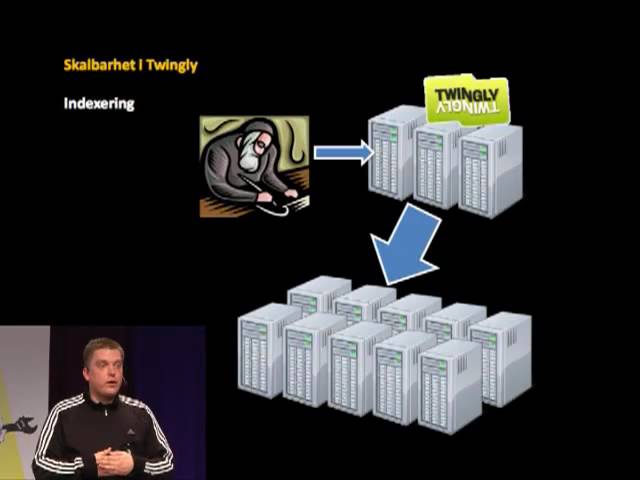
The rebuilt system distributed 128 database tables across multiple MySQL servers, a quarter of the tables to each, deliberately keeping any single table under 10 million rows for manageability ▶ 49:42 ▶ 59:13, fed by a queue-based indexing pipeline that let multiple servers pull blog entries to process in parallel ▶ 31:01. By April 2008 that pipeline was handling roughly 110 million blog entries and 170 million interlinked relationships on about half a terabyte of data ▶ 9:46, on around 30 servers that fit — barely — in a single rack ▶ 1:20:27. Data came in through several channels at once: manual pings, automatic pings from blog platforms like blog.se, Expressen and Aftonbladet, a discovery crawler, and a continuously cycling 'Roundhouse Ping' that refreshed important blogs' RSS feeds on rotation ▶ 1:02:14. The index itself was split by time — a separate index per month for the past year, plus a daily index for the last 24 hours — with old data reindexed weekly and the freshest data reindexed every three minutes ▶ 1:16:26; Martin liked to contrast that with Google's old quarterly 'Google Dance' full-index rebuild as a measure of how much harder real-time search is ▶ 1:15:36. To keep 45 media sites' widget traffic from ever hitting Twingly's own servers directly, backlink data was published straight to S3 as JSON, letting Amazon absorb the load ▶ 1:45:38.
Anti-spam scaling had its own clever mechanism, and its own failure mode.
Whitelist tree tracking defeats spam spam exponentially. Martin describes a clever spam-filtering problem: when they started with a manual whitelist of ~6,000 good blogs and followed links to expand it, spammers would infiltrate the network and spawn exponential spam clusters. The solution: track the approval chain (which blog approved which new blog), so when they discovered a spam cluster, they could trace it upward, cut the link at the legitimate blog that had accidentally approved it, and delete thousands of spam blogs with one click. ▶ 24:01
A related, never fully shipped idea: letting users build 'friend lists' of trusted people whose votes and preferences would weight their personal search results more heavily than the global ranking — social, personalized search without needing a formal moderation or punishment system ▶ 1:35:47. One byproduct of all this link data was simply fun to look at: a network map of 2,000 major Swedish blogs, colored by community — entertainment in yellow, pop culture in purple — with blondinbella.se and tjuvlyssna.se as the two dominant hub blogs and politikerbloggen.se at the center of a dense political cluster ▶ 11:38.
Growth, funding & business model
Twingly raised roughly €1 million (reported elsewhere as 10 million SEK) from Stockholm investor Servisen in July 2007 TechCrunch ↗ ▶ 3:45 — and, deliberately, never raised again. Martin's strategy with Twingly was the opposite of the one he'd later run at Narrative: raise once, then make it last as long as possible ▶ 12:19 ▶ 12:29, a bootstrapped, slow-and-stable posture he still called 'an enormous amount for that time' looking back in 2013 ▶ 4:41. The round itself came from an unplanned encounter, not a pitch deck.
(See the screensaver story above — investor Lars Hallenium first noticed Twingly from the audience at that London conference, and reached out to invest months later ▶ 26:56.)
Twingly's revenue was built on two legs: subscription access to the newspaper/blog widget — priced around 3.9 (currency unspecified in the source) per month above a 100,000-unique-visitors-a-week threshold, bundled with spam moderation and support, with a cheaper API-only tier added later ▶ 23:29 — and selling raw blog and social data to media-monitoring firms (Sition, then the world's largest media-monitoring company, plus Itellio and Retriever) and to PR agencies for custom analysis ▶ 1:00:15. That second business line outlived Martin's tenure by a wide margin: a 2022 methods paper on Swedish web-text research describes Twingly still indexing over a million blog posts and 8,000 new active blogs a day, 10 million forum posts from 9,000 forums, 3 million news stories a day from 150,000 sources in over 100 countries, plus dark-web pages and Russian VKontakte data, with automated entity and sentiment analysis in 35 languages gu.se ↗ — a company that had scraped up to 17 million public Facebook posts a day at some point, though it had quietly stopped mentioning that by 2022 gu.se ↗.
Growth in the early years, by contrast, depended on getting into rooms Twingly hadn't been invited to.
The Van to Vienna. To get Twingly onto the floor of a major newspaper-industry trade show in Vienna — one of only eight exhibitor slots — Martin quietly signed the company up for an international booth before he'd sold the idea to his co-founders, using a small pool of Almi funding. The four founders then rented a van from Sixt and drove 1,800 kilometers through a snowstorm across Europe to get there. As the only exhibitor pitching social media, they drew outsized attention, picked up their first international customers (Helsingin Sanomat in Finland, the Sunday Times in South Africa), and impressed the Swedish papers who saw them representing internationally — cementing a deliberate 'born global' strategy Martin later carried forward, in a much more literal form, into Narrative. ▶ 26:30
By 2010, Twingly had grown well beyond its original two newspaper customers to serve sites across many European countries ▶ 5:59 and was running roughly 300 million widget views a month ▶ 6:50. By late 2011 it had over 100 clients in about 16 countries European CEO ↗ and had grown from four founders to 12 employees — Martin's first company with real hired staff Breakit ↗. Development itself ran in three-week iterations with a week's pause for regrouping and support Tore Friskopp ↗, estimated with user stories on index cards against a Fibonacci scale (1-2-3-5-8-13-21) specifically to avoid false precision, with the team settling into a baseline of about 67 completed points per iteration Tore Friskopp ↗.
Strategy & product philosophy
Twingly is where much of Martin's operating philosophy took shape, largely as a reaction to what worked and what nearly went wrong. The clearest through-line: never launch without a business model, and build the business and the technology at the same time rather than sequentially — he believed that produced real value and self-confidence faster than technology-first sequencing ▶ 1:59. In practice that meant a hard rule of never building anything before a paying customer wanted it Tore Friskopp ↗, because willingness to pay was, to him, a far more reliable signal than customers merely saying they liked something Tore Friskopp ↗. It also meant favoring customer conversations over formal specs — a lesson he traced back to his earlier venture Polyester HB, where long written specifications had become their own burden Tore Friskopp ↗ — and involving customers directly in brainstorming rather than running formal market research Tore Friskopp ↗.
Other recurring principles from the same period: prefer many small iterations over fewer well-tested releases Tore Friskopp ↗; ship a few real features rather than one 'complete' service Tore Friskopp ↗; fix problems later rather than trying to get everything right the first time Tore Friskopp ↗; keep the vision fixed but treat the path to it as negotiable Tore Friskopp ↗; and favor understanding the customer's actual problem over defaulting to building a product Tore Friskopp ↗. Martin summed up the company's self-image as 'a Formula 1 team' — operating at the technical edge while taking carefully calculated business risks Tore Friskopp ↗ — which is exactly the posture behind declining the Melodifestivalen front page (above): the upside was real, but the risk of shipping an untested rebuild in a week wasn't one he'd take.
Growth strategy showed the same caution scaled up. Both Twingly and Narrative launched as deliberately 'born global' companies from day one ▶ 6:24, but where Sweden as a home base gave Twingly fast press traction and easy first customers, it also capped how big the market could get early on ▶ 6:50 — a tradeoff Martin later ran the opposite direction with Narrative, whose home market was the US from the start ▶ 6:24. Both companies also used long, deliberate soft launches — Twingly's was a gradual, nine-to-twelve-month drift from consulting work into product ▶ 12:21 rather than a single hard-cutover launch.
People & culture
Twingly's four founders — Martin, Niklas, Björn and Figge — were still hands-on enough in the early days to personally rent a van and drive it through a European snowstorm for a trade show booth (below). The company's PR was run by Greenhill Relations, led by Åsa and Matti, who'd just left Agent 25 ▶ 30:18. Its Summer of Code program brought in student developers each summer — Jonas ('entrepreneurial, willing to take on anything'), Christopher (strong on Web 2.0 visualization), Helena (shy on camera, detail-oriented) and Fredrik (a tech specialist drawn to hard problems) ▶ 0:20 ▶ 0:37 ▶ 0:49 ▶ 1:03 — and sent a team to the Reboot 10 conference in Copenhagen in 2008 ▶ 0:20.
Around 6–8 employees, Martin looked seriously at introducing Sweden's standard collective bargaining agreement, and concluded, with evident discomfort, that he couldn't justify it: it would have cost the company about 60,000 SEK a year, cutting 8,000–10,000 SEK from the salary budget available per employee Breakit ↗. He also believed compensation and performance should be judged at the level of the team, not the individual — a closed deal is never just one person's win Tore Friskopp ↗.
The company's most instructive internal failure, by Martin's own account, involved Anton, his product manager, and an idea for an internal-communications tool that predated Slack by several years, inspired by the corporate microblogging platform Yammer ▶ 9:24 ▶ 8:59.
The false co-creation workshop at Gotland. At Twingly around 2008, Martin and product manager Anton had months of preliminary work on an internal communication product idea (proto-Slack). Rather than pitching this vision honestly, they gathered the entire company at an offsite in Gotland with the intention of making it seem like a blank-slate co-creation workshop. When the team brought their own creative ideas, Martin and Anton realized their deception had failed—they had already decided the direction but pretended not to. Martin describes this as a deeply shameful learning moment: it was dishonest to fake openness when a straightforward pitch would have been more ethical and enabled genuine co-creation on implementation details. ▶ 10:22
Leaving Twingly
Martin ran Twingly for six years ▶ 0:51 ▶ 24:29, and by his own account the company was, for a long stretch, exactly the kind of formative, hands-on education he wanted — 'a very educational and enjoyable project' ▶ 0:51 that taught him marketing and storytelling on top of his engineering background ▶ 9:48. What ended it wasn't the business struggling; it was the business succeeding into a different shape than the one he wanted to run.
Exiting Twingly via Winter Depression and Clarity. Martin experiences a winter depression while running Twingly, assuming it will lift with spring. When it doesn't, he realizes the darkness is internal, not seasonal—a sign of misalignment between his need to innovate and the company's need to refine existing products and focus on sales. After six years, he recognizes this gap means he must find a new CEO. Rather than abruptly leave, he stays nine months to recruit his replacement, negotiating one day per week to start Narrative. ▶ 14:22
In the summer of 2011 he told the board directly that he wanted to step down Breakit ↗; he and the company, he felt, had simply grown apart, needing pure sales execution where he wanted product innovation Breakit ↗. He negotiated to keep working one day a week on his next idea until a replacement CEO was found Breakit ↗ ▶ 12:21, a search that took nine months, during which he quietly assembled Narrative's founding team Breakit ↗. In one telling of the negotiation he even took a 25% raise to compensate for dropping to four days a week ▶ 25:20 — hardly the exit of someone burning the place down on the way out. Finding the next idea itself was its own deliberate, occasionally bleak process.
The Spreadsheet That Couldn't Commit. While winding down his day-to-day role at Twingly, Martin ran a deliberately structured search for his next company: a Google Spreadsheet of business ideas he added to daily, eventually reaching 45–50, comparing and categorizing them and 'burning' for each one for a couple of days before moving on. It became almost bleak — he worried he could never start a company if he could hold onto an idea for only two days. The pattern broke when he saw a teardown of the Finnish Wi-Fi-enabled SD card 'iFi': it showed him how far miniaturization had come, sent him back to an idea he'd earlier rejected as physically too bulky — a camera worn on the body — and this time it stuck, emotionally, for weeks. ▶ 35:51
Martin was CEO of Twingly from 2006 to 2012 Wikipedia (en) ↗ Wikipedia (sv) ↗. Years later he'd allow that at the time, leaving felt like the wrong call ▶ 12:59 — but the company he left behind kept growing on its own trajectory, expanding into large-scale social-data licensing for media-monitoring firms and researchers well into the 2020s gu.se ↗. What he took from the experience directly shaped the next one: Narrative launched with a far more aggressive growth plan than Twingly ever had ▶ 3:49, built on the same 'born global' instinct but pointed, this time, straight at the US market from day one.
See also: Narrative · Servisen · Primelabs · Polyester · Bloggportalen · Twingly Blog Search · Twingly Channels · Twingly Live · Twingly BlogRank · Twingly Blogstream · Twingly Screensaver · Twingly Microblog Search · Twingly Summer of Code · Project Shinobi · Leaving Twingly CEO role