

Heywear
Heywear was Martin Källström's third venture and his first outside pure software/hardware: a same-day optical retail startup in New York City, built to compress the entire prescription-eyewear process — eye exam, frame selection, lens edging — into a single 30-minute visit for one flat price. Conceived at the end of 2018 by a small, French-inflected founding group and steered day-to-day by an American hospitality-and-operations CEO, Heywear opened its NoHo flagship in March 2021, expanded to as many as five New York locations by mid-2022, raised a few million dollars from hardware- and infrastructure-focused investors, and then quietly closed all its stores by around 2024. Martin's own name barely appears in the company's regulatory paper trail — a detail that, on its own, tells part of the story of what kind of co-founder he was here.
Origins: a bad glasses-buying trip becomes a company (2018–2019)
Corentin Macias's frustration with American eyewear. Macias hadn't needed glasses until adulthood, and when he finally had to get a prescription filled he was stunned by how convoluted American optical retail was — a separate appointment for the eye exam, another trip to an optician to try frames, a third visit for fitting and adjustment. At the time he was working as an investment analyst at the Paris hardware fund HCVC (Hardware Club), and he used the vantage point of a VC evaluating hardware deals to dig into just how underserved the U.S. optical market was — three out of four American adults need glasses, he noted, and the healthcare system offers far less of a safety net than in France. He began laying the groundwork for what became Heywear at the end of 2018. French Morning ↗, Research ↗
- Martin Källström — coming off Twingly and Narrative — is credited as a co-founder and supplied the venture's initial strategic framework; secondary research explicitly connects his prior ventures (Polyester's operational lean-ness, Kindship's later AI focus) to Heywear's ambition of running miniaturized, efficient optical labs inside retail storefronts. This framing comes from an AI research compilation and should be read as such. Research ↗
- Martin's own public self-description of the role varied: his LinkedIn read "Led Heywear in U.S. optical," while his X/Twitter bio listed him as "Founder & CEO of ... Heywear" alongside Polyester, Twingly, Narrative, and Fluent — his exact title, join/leave dates, and whether he relocated to New York for the venture are not documented in public sources. Research ↗, Wellfound ↗
- Idan Cohen — co-founder of Boxee and Grow — was an early co-founder and the company's first CEO, though he does not appear in Heywear's Form D filings after early 2020. Research ↗, SEC EDGAR ↗
- Alexandre Jais, a French software/mechanical engineer with a Stanford master's degree and prior experience at Facebook's Building 8 hardware lab and at Nascent Objects, became co-founder, president, and CTO, leading software and product development remotely from Paris; he has had poor vision since childhood, which fed his personal investment in the project. WWD ↗, Research ↗, French Morning ↗
- Corentin Macias took the Head of Product and Operations role, bringing an early-stage venture perspective from his time at Samaipata and Hardware Club (HCVC), both hard-tech investors. Research ↗
- Before Heywear, Macias had already tried several things: a connected smart-home app built during his Polytechnique/Berkeley MBA, a medical earbud project for monitoring brain activity, and Wyve, a sustainable surfboard startup based in Anglet, France. French Morning ↗
- The team opened a friends-and-family beta studio at the end of 2019, well before any public launch, specifically to refine the on-site lens-cutting machinery. French Morning ↗, Research ↗
- Alexis Houssou of HCVC — the fund where Macias had worked — became an early institutional backer and sat as a director on Heywear's board from 2020 through 2021. SEC EDGAR ↗
- In his own retelling, Martin described spending "the past two years" building a "glasögonkedja" (glasses chain) that started on Manhattan, in New York — his own framing of the 2019–2021 window matches the founding and early-operating timeline documented elsewhere. ▶ 0:42
The model: one visit, one price, no surprises
Heywear's real innovation wasn't a piece of hardware — it was operational. The company built a vertically integrated, direct-to-consumer retail model: it designed its own frames, ran its own stores, employed its own doctors, and owned its own medical-tech and software stack, including small on-site optical labs that cut and edged lenses while the customer waited rather than shipping the job to an outside wholesale lab. Research ↗, French Morning ↗
Flipping the traditional order of operations. At a conventional optical shop, customers pick frames only after finishing their eye exam. Heywear reversed the sequence: customers chose frames first, so the on-site lab could start grinding and edging lenses to the (soon-to-be-confirmed) prescription while the exam was still underway — collapsing what is normally a multi-day, multi-appointment process into one visit. Waitwhile ↗
- The headline promise across nearly every account of the company was the same: a full eye exam, frame selection, and finished, edged prescription glasses in about 30 minutes (WWD reported a 30–60 minute range; Waitwhile's own case study cited "within the hour"). WWD ↗, Waitwhile ↗
- Pricing evolved over time. At launch in 2021, glasses (with prescription) ran $50–125, sunglasses about $25 more, and a stand-alone eye exam was $50; the whole exam-plus-frame-plus-lenses bundle was also marketed at a flat $99. By 2022 the flagship bundle had risen to a $149 flat price, and — per one AI research compilation — the company later added bundling tiers (two pairs for $169, three for $229) to lift average order value. AC Magazine ↗, Waitwhile ↗, Research ↗ (the $99→$149→bundling progression is drawn from a secondary research compilation and hasn't been independently corroborated against contemporaneous pricing pages)
- CEO Jaclyn Pascocello framed the goal explicitly: "We're focused on making the process of buying prescription eyewear the same as buying a pair of jeans. We want to make it more accessible, and make it an impulse buy for the first time ever." WWD ↗
- Heywear built its scheduling and lab-management software entirely in-house — Jais and his team wrote all of it — while contracting Waitwhile, an outside digital queue-management platform, to run the customer-facing side: tracking which guests were in which channel (exam, frame selection, lab) at any moment and texting customers when their glasses were ready, so they could leave the store and run an errand instead of waiting in a chair. WWD ↗, Waitwhile ↗
- Derek Kastner, Heywear's Manager of Training and Development, praised how easy Waitwhile was for staff to learn and for guests to use, calling out the low-touch, close-to-paperless experience it enabled. Waitwhile ↗
- The company deliberately scoped itself narrowly to keep the 30-minute promise achievable: no insurance accepted, no contact-lens exams, no dilations or treatment of eye disease, and — critically — no bifocal, trifocal, or progressive lenses, and no children's eyewear. AC Magazine ↗, INVISION Magazine ↗
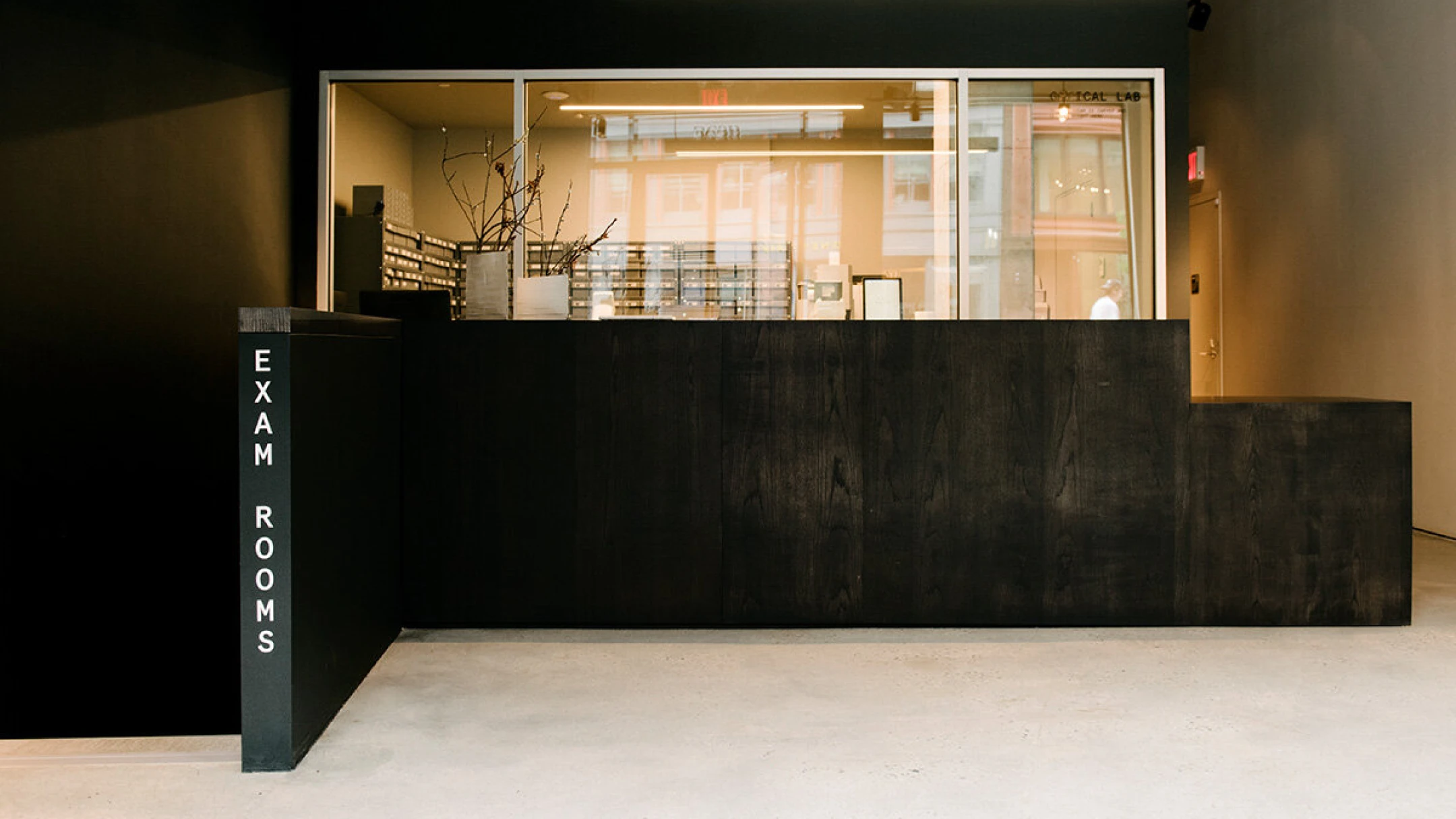
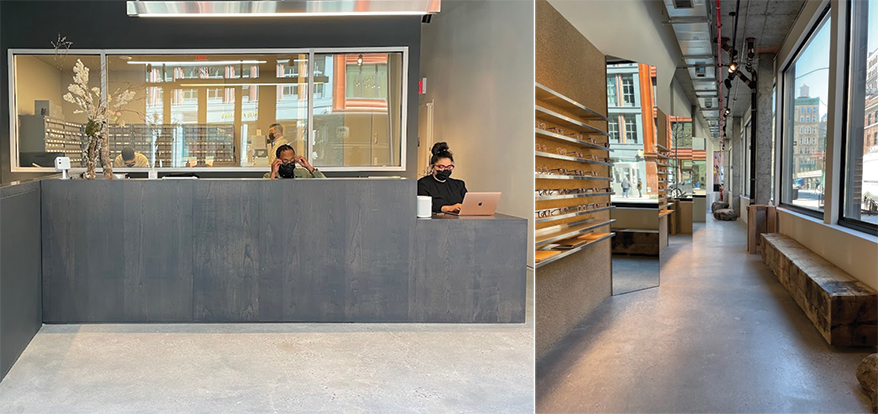
- On-site labs ran small — about 250 square feet — while the flagship itself spanned 2,500 square feet across two floors; Heywear called this a "hyper-local" model, where a flagship's lab and inventory served as a manufacturing and fulfillment hub for smaller satellite stores nearby. WWD ↗
- Pascocello said high replacement-lens costs are a real barrier that keeps many Americans from getting their eyes checked and their prescriptions updated regularly — the flat, low price was meant to remove that friction and encourage repeat visits; she reported customers often returned within six months to buy a second pair. WWD ↗
The NoHo flagship
Full operational detail — location, customer flow, virtual queue, equipment — lives on the dedicated project page: Heywear NoHo Studio.
Heywear's flagship studio opened at 363 Lafayette Street at Bond Street in Manhattan's NoHo neighborhood in March 2021, stocking more than 3,000 distinct lens types on-site to handle volume without outside dependencies. Research ↗, French Morning ↗
Clinical technology
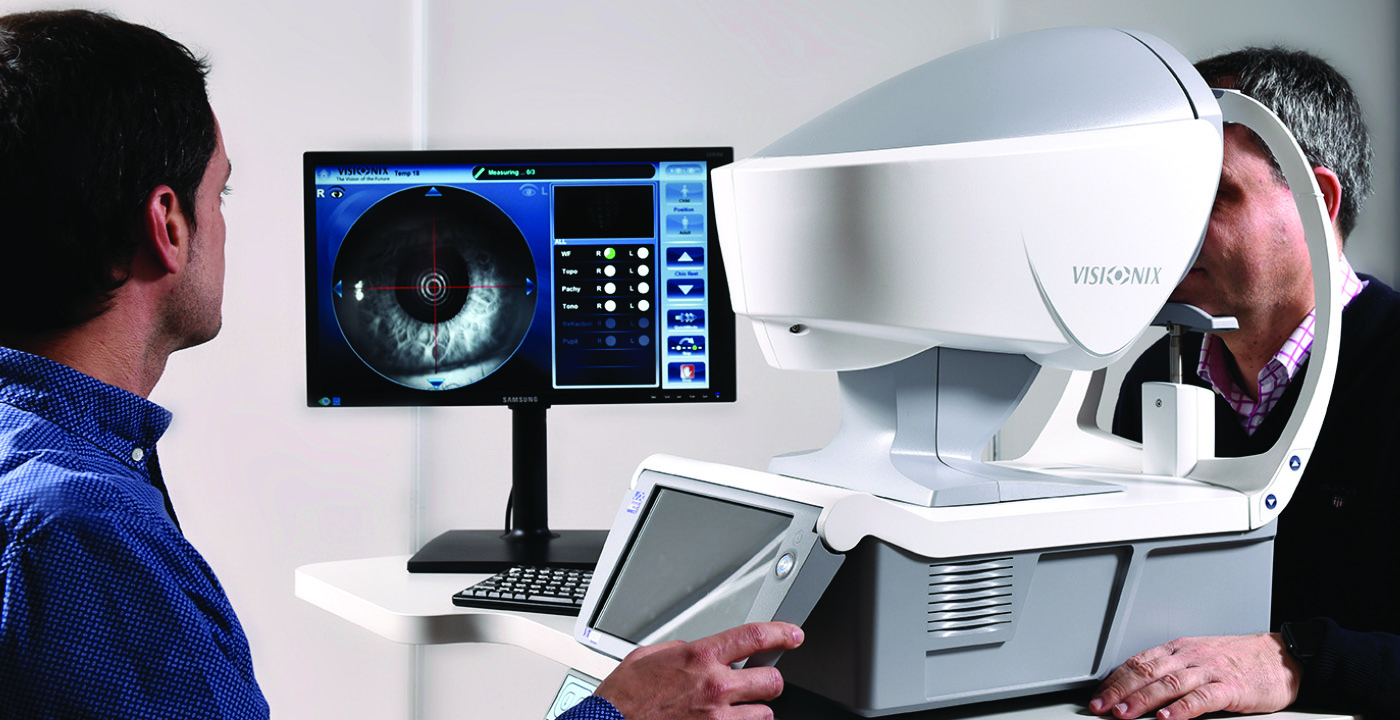
Heywear's speed depended on real diagnostic hardware, not just process design. The company installed a Visionix VX 120+ multimodal screener in February 2019 — well before its public launch — a fully automated device that maps the anterior segment of the eye in roughly 90 seconds. It objectively measures visual acuity via wavefront aberrometry, assesses corneal shape through topography (catching complex astigmatism), measures anterior-chamber angles to flag glaucoma risk, and screens for cataracts. Review of Optometric Business ↗, Research ↗
- Dr. Lilan Le, OD, served as Heywear's Director of Optometry Operations (also described elsewhere as director of optometric services) and wrote publicly about the company's equipment choices; she framed the VX 120+ as core to hitting the 30-minute promise while still "maximizing efficiency and level of patient care." Review of Optometric Business ↗, INVISION Magazine ↗
- Heywear also placed a second Visionix device, the VX 40 wavefront lens analyzer, at the service desk, letting staff quickly verify a patient's current prescription, recommend frames, and troubleshoot during busy periods. Review of Optometric Business ↗
- Le described the company holding every location to the same standard: identical equipment, identically trained staff, and the same customer-service bar in every exam lane, so the 30-minute promise held regardless of which store a customer walked into. Review of Optometric Business ↗
- One AI research compilation observed that the VX 120+ did double duty beyond pure clinical throughput: its built-in high-definition displays let doctors show patients a visual representation of their own eye health, which the analysis argued increased perceived value, clinical trust, and patient retention — a deliberate product-psychology choice, not just a diagnostic one. Research ↗
- The same research documented the hard physical ceiling on the model: complex prescriptions — high-index lenses for severe myopia, progressive multifocals for presbyopia, or prism lenses for strabismus — cannot typically be surfaced and coated in a retail environment; they require custom fabrication at heavy industrial wholesale labs, which negates the 30-minute promise outright for a meaningful share of the market. Research ↗
Brand & design
Center's brand identity. Heywear commissioned CENTER, an award-winning Brooklyn-based design studio founded by Alex Center (known for brands including Vitaminwater, SmartWater, Kin Euphorics, and Good Light), to build its visual identity from scratch. Center's own framing of the brief: "Our branding is a celebration of both sides of the experience, bridging the gap between the technical process of optometry and the gift of self expression." CENTER ↗, Research ↗
- One AI research compilation additionally credits Savvy Studio as a collaborator alongside CENTER on the brand's aesthetic and spatial architecture; this detail comes only from the secondary research pass and hasn't been corroborated against a primary source. Research ↗
- The physical retail space was deliberately designed to read like a contemporary art gallery rather than a medical office — stripped of the clinical signifiers that make eye exams feel intimidating, per the same research compilation. Research ↗
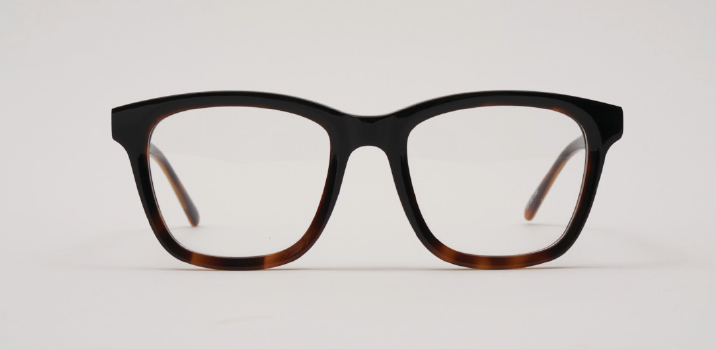
- The company's proprietary frame collection launched with 33 exclusive designs across an array of colors, yielding more than 130 distinct style combinations — fast-fashion-style SKU variety applied to prescription eyewear. AC Magazine ↗, Research ↗
- New York–based eyewear designer Selin Olmsted, who had spent years designing at Warby Parker before founding her own independent studio, was recruited to conceive and execute that entire launch collection rather than have Heywear rely on third-party wholesale frames. INVISION Magazine ↗, Research ↗
- Per the research compilation, Olmsted's industry standing continued well past Heywear's own decline — she was still presenting on eyewear design trends at OPTI 2026's Design Stage and at SILMO Istanbul 2025, evidence the designer ecosystem around the brand kept moving independently of the retailer's fate. Research ↗
Leadership: Pascocello as CEO, and the question of Martin's role
Jaclyn Pascocello's path to Heywear. Pascocello's career ran from Wall Street (stints at Smith Barney, Merrill Lynch, and Cowen, per a research compilation) into hospitality operations at Hillstone Restaurant Group, where she said she mastered "human behavioral psychology and premium customer service" managing high-volume restaurants. From there she became COO of Spacious, a startup that converted empty daytime restaurants into drop-in coworking space and was later acquired by WeWork — direct-line experience in turning underused physical space into a fast, repeatable customer flow, which she then brought to Heywear as its operating and public-facing CEO. Research ↗, French Morning ↗
- Pascocello was explicit about the mission driving the pricing model: she believed the cost of vision insurance and traditional exams had turned eye care into an exclusionary luxury, and she wanted flat, transparent pricing to democratize access. Research ↗
- She put Heywear's customer base mostly in the 18–40 age range, though the company served people of all ages, and described the company's core operating philosophy in one line: "our entire model is focused on one visit, one price, no surprises." WWD ↗
The notable gap in the SEC record. Heywear Inc. filed four Form D exempt-offering notices with the SEC between January 2020 and May 2021. Martin Källström does not appear as a related person — officer, director, or promoter — on any of the four. Alexandre Jais is listed as an executive officer continuously across all four filings; Jaclyn Pascocello joins as an executive officer starting with the February 2021 filing; Idan Cohen appears as an executive officer only on the earliest, 2020 filing; and the board of directors named across the filings — Alexis Houssou (2020–2021), and, from February 2021, Romain Afflelou and Marc Menasé — likewise never includes Martin. Read plainly, this is evidence that whatever role Martin played at Heywear, it was informal and strategic rather than a filed corporate office — a materially different footing than his roles at Twingly or Narrative, where he was CEO of record. SEC EDGAR ↗
Funding
- Heywear's earliest capital was angel seed money in 2019 from Eduardo Ronzano, per aggregator records. Research ↗
- SEC filings put the amounts actually sold across the four 2020–2021 Form Ds at roughly $200,000, $1.85 million, $865,000, and $280,000 — about $3.2 million in aggregate across the filed rounds. SEC EDGAR ↗
- A separate account describes a $1.3 million equity raise closing in March 2021, secured largely through Pascocello's own fundraising efforts and earmarked for product development and physical expansion — this appears to correspond to activity around the same period as the SEC filings, though the two accounts aren't reconciled to the dollar. Research ↗
- Deal-tracking aggregators (Dealroom, per the research compilation) describe a ~$2.1 million seed round in May 2020 led by HCVC and YADAY, and a ~$1.1 million seed round in May 2021 from Founders Future, HCVC, Tango, and Stella Capital, plus participation from VC firm Techmind in January 2022. A Series A was signaled for 2022 but, as far as public records show, never closed. Total lifetime funding is reported inconsistently across aggregators, in a $2.7–5 million range. Research ↗
- Stella Capital, one of the notable institutional backers, is an early-stage fund (a spinoff from an Asia/U.S. family office) whose thesis centers on the "infrastructure of everyday life" — companies that change how people live, move, and transact — a framing the research compilation argues made Heywear a natural fit for their portfolio. Research ↗
- Heywear told WWD in April 2022 it was venture-backed and preparing to raise a Series A "in the coming months." WWD ↗
Growth and expansion
- The March 2021 NoHo flagship was followed by a second New York location in downtown Brooklyn, reportedly already in planning as early as the NoHo opening. WWD ↗, AC Magazine ↗, INVISION Magazine ↗
- By April 2022 Heywear had two open NYC locations (NoHo flagship and Brooklyn) and a third about to open near the Flatiron building at 23rd Street and Fifth Avenue; by June 2022 the company projected five New York City locations total, adding Williamsburg and the Upper East Side. WWD ↗
- Heywear had served over 12,000 customers by the time of its Waitwhile case study, and had accumulated roughly 250 five-star Google reviews by early December 2021. Waitwhile ↗, INVISION Magazine ↗
- The company's stated ambition was aggressive: a five-year goal of 100 full-scale U.S. locations (as of an October 2021 profile), Miami targeted for the second half of 2022 as the next market beyond New York, and Boston and Washington, D.C. also under consideration. Pascocello's longer horizon: being within an hour's travel of most Americans within five to ten years. AC Magazine ↗, WWD ↗
Closure, ~2024 — and why
By 2024, industry observers and consumer reports confirmed all of Heywear's New York retail locations had permanently closed. What follows draws on an AI research compilation's forest-level analysis of the company's arc, not on a contemporaneous closure announcement, and should be read with that caveat. Research ↗
The research's headline judgment: Heywear "succeeded brilliantly as an operational and technological proof-of-concept, but faltered as a sustainable enterprise, ultimately demonstrating that while technology can accelerate manufacturing workflows, it cannot easily untangle the deeply entrenched regulatory, financial, and physiological realities of the American vision care market." Research ↗
- Real estate and staffing costs outran baseline revenue. Running a rapid on-site lab demanded a large physical footprint — premium commercial rent to house heavy industrial edgers and full clinical exam lanes alongside a retail showroom — and the research argues the revenue from baseline single-vision packages simply wasn't enough to cover both the cost per square foot and the payroll of licensed optical staff. Research ↗
- The 30-minute promise structurally excluded the most valuable customers. By optimizing exclusively for speed and standard single-vision prescriptions, the research argues Heywear alienated the most lucrative segment of the optical market — older customers needing progressive lenses and anyone with complex refractive needs — because those prescriptions carry the highest lifetime value in optometry but are fundamentally incompatible with retail-based, same-day manufacturing. Research ↗
- The Medicaid pricing episode. In one narrative captured by the research pass, a customer with Medicaid coverage came in expecting an accessible price for a medically necessary prism-lens prescription. Told the store carried no dedicated "Medicaid frames," they were instead offered a $150 discount against premium inventory running up to $950, then upsold on anti-glare coating and high-index lenses, landing a $750 out-of-pocket bill; asking to swap in their own frame to cut costs, they were quoted $550 for the lenses alone. The research reads this as exposing a real tension between Heywear's democratization marketing and the underlying cost of manufacturing medically complex lenses — this is a single account surfaced by the research compilation, not independently verified, and is included here as an illustrative data point rather than a confirmed pattern. Research ↗
- CEO Jaclyn Pascocello moved on to Fabrik, a startup building "third-space community networks in empty office spaces" to address urban loneliness — a thematic echo of her earlier work at Spacious. The research pass reads the speed of this pivot as a sign Heywear was one stop on a longer founder thesis about repurposing underused space, rather than an end in itself. Research ↗
- After Heywear, Martin returned to Sweden and moved into new ventures — Multiply.co, where research describes him as founder/CPO/CMO, and later AI work including Kindship.ai. Research ↗
Legacy in wearable technology
Heywear sits inside Martin's longer arc in wearable and body-adjacent hardware. He has connected it directly to Narrative Clip and, later, to Meta's AI glasses — arguing Meta finally fulfilled a vision both of his own earlier ventures were reaching for: hardware that captures your world and runs capable AI on top of it. Where Google Glass failed, in his telling, by being "too nerdy and techy and looked very dangerous," Meta succeeded by getting the form factor right and shipping strong multimodal AI alongside the hardware. ▶ 2:35, ▶ 3:01
Personal context: New York and an opening to plurality
Martin split his life between New York and Sweden through the Heywear years, and by his own account the period brought an identity crisis alongside the business one. He discovered Eckhart Tolle's The Power of Now, which reframed how he understood emotion and selfhood: "Du är inte dina tankar och du är inte din kropp. Tankar, känslor och smärta är någonting du har, inte någonting du är" (You are not your thoughts and you are not your body. Thoughts, feelings and pain are something you have, not something you are). ▶ 3:25, ▶ 6:59
After returning to Sweden and rereading the book with fresh eyes, then moving back to New York, he met a polyamorous woman on Tinder who became his guide into a new relational world — an awakening to plurality, both philosophical and relational, that he has said ran alongside the Heywear years. ▶ 7:54
People
- Martin Källström — co-founder; supplied Heywear's initial strategic framework; absent from all SEC-filed officer/director records, evidence his role was informal and strategic rather than a filed executive position.
- Jaclyn Pascocello — operating and public-facing CEO from 2021 onward; previously COO of Spacious (acquired by WeWork).
- Alexandre Jais — co-founder, president, and CTO; built the software stack; consistent executive officer across all four SEC filings.
- Corentin Macias — co-founder, Head of Product and Operations; originated the idea while at HCVC.
- Idan Cohen — early co-founder and first CEO; co-founder of Boxee and Grow.
- Selin Olmsted — designed the launch frame collection; ex-Warby Parker.
- Alex Center — founder of CENTER, the studio behind Heywear's brand identity.
- Dr. Lilan Le, OD — Director of Optometry Operations; oversaw the clinical technology stack.
See people & partners for fuller profiles, and Heywear NoHo Studio for the flagship's operational detail.