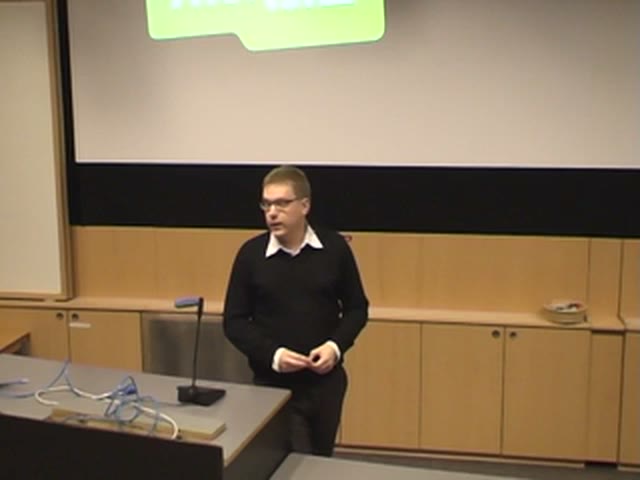


The newspaper race
In the early spring of 2007, Sweden's two morning papers, Dagens Nyheter and Svenska Dagbladet, switched on the same small widget from a four-person company in Linköping within a day or two of each other, and each was convinced the other had been allowed to go first. That collision is Twingly's origin story, and Martin has told it at least twice on record: in 2010 to a room of web engineers as a scaling problem, and in 2014 to a podcast host as a piece of luck, prefaced with the offer of a sanitised version or a true one. The two tellings disagree on small facts and agree on the moral. Around them sits a press record from 2007 to 2012 that shows what the accident turned into.
What Twingly was selling the papers
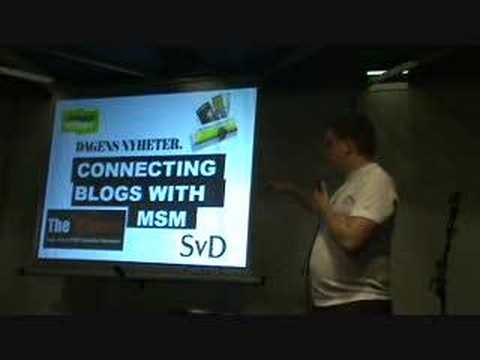
The product was a link in both directions. Newspapers got automatic links from their articles back to the blogs discussing them; bloggers got readers from the newspapers. In a 2007 interview Martin describes it simply: "Twingly funktionen gör ju att bloggarna kan jobba ihop med traditionella medier" (the Twingly function lets bloggers work together with traditional media), and admits that media companies were chosen partly because "att jobba med just medieföretag för att då kan vi få lite publicitet samtidigt" (working with media companies means we get some publicity at the same time). ▶ 0:01 ▶ 0:51 At Podcamp Europe that year the customer list was DN, SvD, Helsingin Sanomat and a South African news site, and the pitch was that the Swedish papers were seeing roughly 200 per cent more blog links pointing at their articles. ▶ 2:16 ▶ 2:42 When TechCrunch met him at DLD in January 2008 the story had become a search engine with a newspaper business attached: "he says he already has some deals with large European publishers completed". TechCrunch ↗ A 2011 blogger's how-to captures the daily mechanics: write about an article, link it, ping Twingly, and a little later the newspaper links back to you. Björn Rutgersson IT-Blogg ↗ See Twingly blog search.
The 2014 telling: the sanitised version and the true one
When Mikael Zachrisson asks on Startuppodden what the key to Twingly's early heat was, Martin answers: "Ja, jag kan ju berätta den tillrättalagliga versionen och den sanna versionen om det." (I can tell you the tidied-up version and the true version.) The host asks for the true one. ▶ 19:33 The true one begins with a confession that "som med allting så var det väldigt många tillfälligheter som klaffade" (as with everything, a lot of coincidences clicked). DN had been "extremt snabba på att hoppa på det där" (extremely quick to jump on it) because they had already tried to procure exactly this and found nobody who could deliver. Then they stalled. ▶ 19:47
By February 2007 both papers' tech departments were ready to test. DN had signed first but "dragit ut väldigt mycket på tiden med att gå live" (dragged out going live a great deal); Twingly nagged weekly and was told other projects came first. Then SvD's Martin Jönsson "bara nämnde att nu händer det någonting spännande inom kort på sved.se" (merely mentioned that something exciting would soon happen on svd.se). "Och då såg Dagens Nyheter det där och tänkte att nu måste vi gå live" (DN saw that and thought, now we have to go live), put up a test version, SvD saw it and put up theirs. "Vi hade verkligen velat ha Dagens Nyheter ute först" (we had really wanted DN out first), because it felt fair, and instead both went live the same day without anyone planning it. ▶ 21:55
The aftermath is where the telling turns. "båda tidningarna tyckte att vi hade behandlat dem oschysst i någon mening" (both papers felt we had treated them unfairly in some sense), and "Dagens Nyheter var rejält sura under ett par dagar" (DN was seriously sore for a couple of days). But "så blev det ett enormt stort genomslag tack vare att båda morgontidningarna gick live samtidigt" (the impact was enormous precisely because both morning papers went live at once). Then the line that makes it a story about ignorance rather than cunning: "Egentligen kan man inte ha både Bonnier och Schibsted som leverantör till båda två. Men det visste ju inte vi. Små entreprenörer från Linköping." (Really, you can't supply both Bonnier and Schibsted. But we didn't know that. Small entrepreneurs from Linköping.) "Det är en i raden av okunskaper som har varit väldigt nyttiga" (one in a series of ignorances that have been very useful). ▶ 22:51 The telling wobbles on its own chronology: a few minutes earlier he had said "Så 2005 så lanserade vi Twingly då på Dagens Nyheter och Svenska Dagbladet", been corrected by the host, and settled on "2007 lanserade vi på de här tidningarna." ▶ 13:11 ▶ 13:48
The 2010 telling: the same collision as a load problem
Four years earlier, at the Optimera Stockholm conference, the story is the same but the hero is the architecture. "Fyra tekniker som började i Linköping." (Four engineers who started in Linköping.) They built a widget they meant to put on every news site in the world, which meant handling all those sites' combined traffic, because "Det skulle vara en molntjänst även om den terminologin inte fanns då" (it was going to be a cloud service, even though the term didn't exist yet). ▶ 3:54 The dates are more precise here: "Vi fick först DN som kund och sedan SVD några veckor senare." (We got DN first and then SvD a few weeks later.), in the autumn of 2006. ▶ 4:19 The worry is framed from the founders' side: "Men vi var lite oroliga över att Svenska Dagbladet skulle lansera före DN. För DN hade ju faktiskt varit före med att signa upp." (We were a bit worried SvD would launch before DN, since DN had actually signed first.) Then: "Så skrev Svenska Dagbladet i en blogg så här att snart kommer det hända roliga saker kring bloggvärlden här på sved.se. Och då fick DN panik" (Then SvD wrote in a blog that fun things would soon happen around the blog world on svd.se, and DN panicked). ▶ 5:09
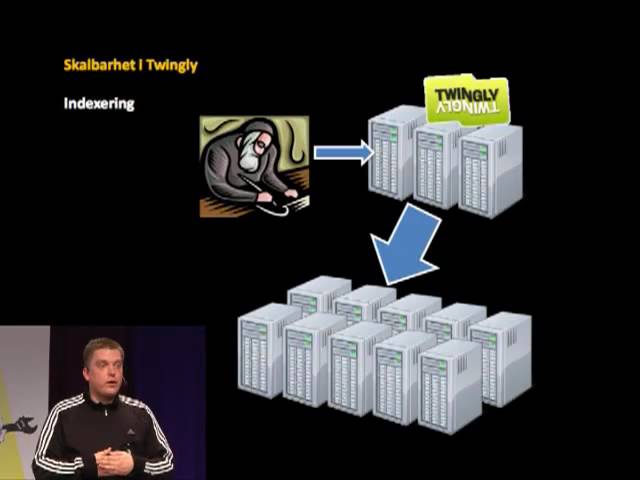
The 2010 ending: "Så att både SVD och DN lanserade samma vecka, två dagar efter varandra. Båda hävdar att det var den andra tidningen som lanserade först." (So both SvD and DN launched the same week, two days apart. Both claim the other paper launched first.) And the effect on the blogosphere: "det sågs som en revolution för hela bloggvärlden" (it was seen as a revolution for the whole blog world), because bloggers could now get attention from newspapers. ▶ 5:34 So the drift: two days apart in 2010, the same day in 2014; a blog post from SvD in 2010, a passing mention by a named editor in 2014; no fury in 2010, and no Bonnier-versus-Schibsted taboo either. What the 2010 version adds is the scaling boast, that in 2010 "vi hanterar alltså de här sajternas sammanlagda trafik på exakt samma lösning som vi lanserade för tre år sedan" (we handle all these sites' combined traffic on exactly the same solution we launched three years ago), now for 115 sites in ten countries. ▶ 6:24 The 2008 architecture talk at Lysator explains how: widget data was published as JSON to Amazon S3, so that the papers pulled from Amazon and Twingly's own load depended on how many blog posts came in, not on how many newspapers were connected. ▶ 105:38 ▶ 106:30 Details in Scaling architecture.
What the press recorded
Neither telling was recorded at the time, but the outcome was. By April 2008 the Lysator programme could introduce Twingly as a company that "från att ha varit helt okänt för bara ett år sedan nu samarbetar med några av de största tidningarna i Europa" (from completely unknown just a year ago now works with some of Europe's biggest newspapers). UppLYSning (Lysator) ↗ In the talk itself Martin reports "Som jag sa så är vi uppe i 45 sajter nu i sju länder." (As I said, we're up to 45 sites now in seven countries.), with Público, La Vanguardia and De Telegraaf all launched that week. ▶ 22:29 ▶ 17:42 The counts in print never quite agree with each other, which is its own kind of drift: fourteen European newspapers and one South African for The Next Web, The Next Web ↗ 50 large news sites led by DN for Teknikfreak, Teknikfreak ↗ 50 newspapers and e-commerce sites in the company's own press release, Mynewsdesk (Twingly newsroom) ↗ 139 partners in 15 countries by late 2011. Björn Rutgersson IT-Blogg ↗ By 2009 Ny Teknik was describing a bridge-builder whose customers were no longer only papers: "Bland kunderna finns ICA, Lindex och tyska Handelsblatt." Ny Teknik ↗
Two items close the loop on the fury. In February 2009 it was SvD's own developer blog that sat Martin down for the first instalment of an interview series with net entrepreneurs, introducing him as "vd för söktjänsten [Twingly]"; the paper that had felt cheated two years earlier was now filming him. SvD Utvecklingsbloggen ↗ And the rule that you cannot serve both Bonnier and Schibsted turned out to be bendable: in December 2011 Twingly bought Bloggportalen from Schibsted's Aftonbladet, and "both Aftonbladet.se and E24.se are moving to Twingly to show blog links on their news articles". ArcticStartup ↗ On the podcast, when Zachrisson asks whether you really cannot have both, Martin concedes that it works, you just have to come in the right way. ▶ 22:51 See Bloggportalen.
Why he keeps telling it
The race matters to Martin because it is his cleanest evidence that a breakout can be neither planned nor deserved, only made possible. He follows it, in 2014, with the two thesis students on a London stage and then the general law: "Det som är betydande är alltid slump" (what matters is always chance), and success is how hard you work at creating the situations where chance can pay off. ▶ 25:28 That argument gets its own page in Luck is having all your tentacles out. The 2010 audience got a different coda from the same company: three years after DN and SvD, Aftonbladet asked to put Twingly Live on its front page for Melodifestivalen, around 500,000 visitors a day, and Martin said no, because rebuilding the long-polling backend in a week left no time to test. ▶ 40:03 ▶ 42:36 The young company that had not known what it was not allowed to do had become one that knew what it could not yet handle. See Twingly Live.
Worth remembering
- DN signed first and stalled; a hint from SvD panicked DN into a test launch; SvD followed; both were furious. ▶ 21:55 ▶ 5:09
- Same day (2014) or two days apart (2010): the story drifts, and both papers still claim the other went first. ▶ 22:51 ▶ 5:34
- Not knowing you cannot supply both Bonnier and Schibsted was one of a series of useful ignorances. ▶ 22:51
- From unknown to 45 sites in seven countries in a year, on the same architecture that later carried 115. UppLYSning (Lysator) ↗ ▶ 22:29 ▶ 6:24
- The papers came round: SvD's developer blog interviewed him in 2009, and Aftonbladet moved to Twingly in 2011. SvD Utvecklingsbloggen ↗ ArcticStartup ↗