



Luck is having all your tentacles out
Ask Martin how Twingly or Narrative got their breaks and he will not give you a strategy. He will give you a coincidence, and then insist that the coincidence was the strategy. In Swedish, in 2014, the claim is that what matters is always chance; in English, in 2021, it is that luck does not exist. Those sound like opposite positions, but they are the same idea told from two ends: the decisive moments cannot be planned, so the founder's actual job is to manufacture as many situations as possible in which chance has something to land on. He argues it the same way every time, with the same handful of stories: two unpaid students on a London stage, two newspapers colliding, a suitcase in a London office, and a coffee in Lund that produced a co-founder.
The claim, in two languages
The 2014 version comes near the end of a long Twingly story on Startuppodden. "Det som är betydande är alltid slump. Och om man är framgångsrik som entreprenör är ju hur hårt man satsar på att skapa de här situationerna där slumpen kan leda till bra saker." (What matters is always chance. Whether you succeed as an entrepreneur comes down to how hard you work at creating the situations where chance can lead to good things.) ▶ 25:28 The practical corollary follows immediately: "Man ska ju verkligen satsa framåt jättestort och göra hundra saker. Men vilken av de här hundra som leder någonstans är ju aldrig förutsägbart." (You should really push forward big and do a hundred things. Which of the hundred leads anywhere is never predictable.) ▶ 25:28 And when host Mikael Zachrisson adds that you then have to take the chance when it appears, Martin agrees: "Och vågar ta chansen när någonting bra uppdagar sig." ▶ 25:28
Seven years later, on a Linköping Science Park webinar, the same thought has compressed into a line: "Luck doesn't exist. Luck is about having all your tentacles out all the time." ▶ 48:46 The tentacles are literal: talking. "Some people think that they need to keep their startup idea secret so that people will not steal it." For deep tech that may hold, he says, but "for the 99.9% of the rest of the companies, that's how you kill your company", because "You need to be super excited to everyone you meet because you never know where" the moment will come from. ▶ 48:46 The 2011 version, given to a blogger who interviewed him as Twingly's CEO, is the calmest of the three: "Man måste pulsera mellan att ha hårt fokus på en grej och att vara helt öppen för många olika saker." (You have to pulse between hard focus on one thing and being completely open to many different things.) Tores sagor från verkligheten ↗
Two nineteen-year-olds and five unscheduled minutes
The story he reaches for first is the Twingly Screensaver, the world-map visualisation that TechCrunch called "a nifty screen saver that shows blog posts on a world map as they are written" TechCrunch ↗ and The Next Web filed under fun products. The Next Web ↗ It was built by two thesis students, Linus and Malin, and the company could not pay them: "vi hade inte råd att betala dem någon ersättning för exjobbet så vi skickade dem på Future Web Apps i London istället" (we couldn't afford to pay them anything for the thesis, so we sent them to Future of Web Apps in London instead), with orders to promote the screensaver somehow. ▶ 19:47
In London, "de var små 19-åriga studenter som var lite nervösa" (they were small, nervous 19-year-old students). They spotted two attendees who looked as young as they were, walked over and asked what they thought. The answer, as Martin retells it: "Wow, this is the coolest thing ever! We know the organizers, you must be on stage!" ▶ 23:45 The organisers gave them five minutes, something Martin says he has never seen at a conference before or since: "Vilket aldrig någonsin jag varit med om på en konferens." Back in Linköping the founders got a text saying the two would be on stage in ten minutes. The pitch drew big applause: "Alla var jätteglada över att få se någonting från en startup istället för de här storbolagspitcharna." (Everyone was delighted to see something from a startup instead of the big-company pitches.) ▶ 24:10
The payoff sat in the audience: "Lars Hallenium som var investment manager på ett investmentbolag här i Stockholm som heter Servisen" (Lars Hallenium, investment manager at a Stockholm investment company called Servisen), who decided a Swedish company showing itself off in London might be worth a call, and became an investor a few months later. ▶ 24:35 The paper trail agrees on the outcome and wobbles on the number: TechCrunch reported "The company has raised €1 million in a July 2007 round of financing from Servisen." TechCrunch ↗ while Martin, speaking to Linköping students in April 2008, put it at 10 million kronor from the same firm the previous summer. ▶ 3:45 "Det är sådana här tillfälligheter som leder stora steg framåt." (It is coincidences like these that lead to big steps forward.) ▶ 25:28 See Servisen.
Two newspapers, one day
The second proof is the newspaper race, which has its own page. In short: Dagens Nyheter signed first and stalled, Svenska Dagbladet's Martin Jönsson hinted publicly that something was coming, DN rushed a test version live, SvD followed, and both morning papers were furious at a company that had engineered none of it. ▶ 21:55 In 2010 he told it as two days apart; in 2014 as the same day. ▶ 5:34 ▶ 22:51 What makes it a luck story rather than a sales story is his own gloss on the company's ignorance: "Det är en i raden av okunskaper som har varit väldigt nyttiga" (it is one in a series of ignorances that have been very useful). ▶ 22:51 He offers it to Zachrisson explicitly as the true version rather than the tidy one. ▶ 19:33
A suitcase in a London office
The Narrative version of the same pattern is the Passion Capital seed round. Told to Breakit's podcast in 2017: the team had built a good deck and a strong founding group, Björn with ten years of digital cameras, Oskar on marketing, Sebastian Björklid who had founded Bildagboken, and was about to start a structured pitch process when "vi trillade in för ett första möte hos Passion Capital i London lite grann av en slump" (we tumbled into a first meeting at Passion Capital in London a little by chance). ▶ 9:40 ▶ 10:06 The investors asked why the founders had stayed overnight, reading between the lines for other meetings. "Man kan inte sitta och säga att vi inte hade råd att flyga över dagen, att det var för dyrt. Så då sa vi någonting om att vi hade ett par andra möten igår." (You can't sit there and say you couldn't afford a same-day flight, so we said something about a couple of other meetings yesterday.) Fear of missing out did the rest: "Hörde de av sig direkt efter mötet och sa att vi vill ge er ett erbjudande." (They got in touch right after the meeting and said they wanted to make an offer.) A term sheet came the following week. ▶ 10:31
The 2015 telling, to Breakit's reporter, is a little different, and the drift is instructive. There the road in was six founders of Passion-backed companies vouching for him: "Martin Källström kände sex andra bolagsgrundare som fått finansiering därigenom så han bad dem att gå i god för honom." And the suitcase moment is a refusal rather than a bluff: "jag vågade inte säga att vi inte haft råd att flyga över dagen, utan sa istället 'det kan jag tyvärr inte svara på.' Det tolkade de som att vi pitchade andra också." (I didn't dare say we couldn't afford the day flight, and said instead that unfortunately I couldn't answer that. They took it to mean we were pitching others too.) Breakit ↗ Either way, Passion put in €500,000 alongside angels Peter Read and Felix Petersen, The Next Web ↗ in May 2012, two months after the founders had gone full time. ▶ 1:55 Martin's own verdict on taking the first offer is the flat-hunting analogy: the first flat you see is lovely, "Man vet ju inte alls vad man missar. Men vi satsade på hastighet" (you have no idea what you're missing, but we bet on speed). ▶ 10:56 More on the investor side of this in Fundraising & investors.
Asking for a referral and getting a co-founder
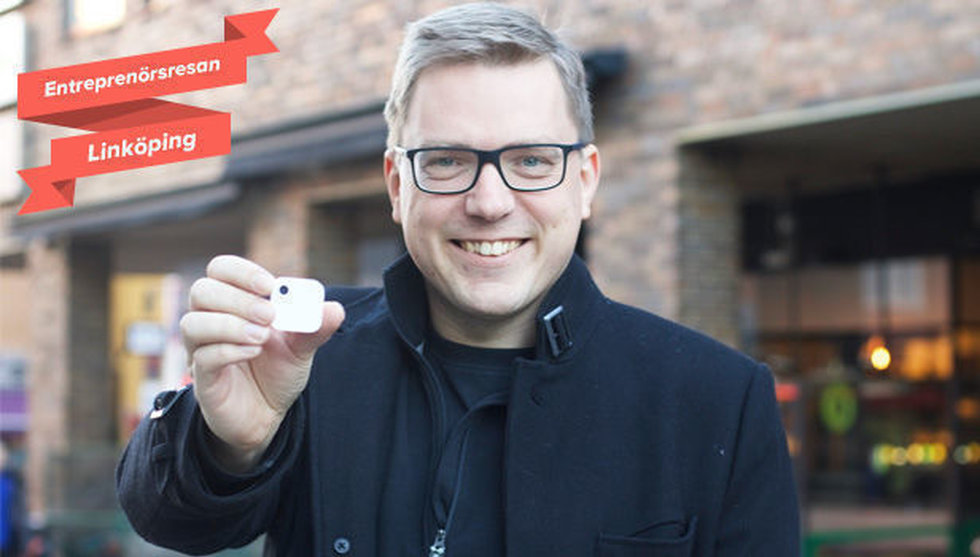
The story that produces the tentacles line is about recruiting Narrative's hardware co-founder. Martin's framing is that great people are never on the market: they never announce they are looking until they have already found something. So instead of asking anyone to join, he asks who he should be asking. "I thought I only knew one person that could build hardware." That was Johan Rissmyr, ex-Axis, now CEO of Castor. Johan did not know either, but suggested Björn Westin, head of R&D at Axis, with the caveat that Björn would never come himself but would know who was good. ▶ 47:03
Martin went to Lund anyway. "I showed him my prototype that I was always walking around with", talked through everything he was trying to do, and went home. Björn called the next day: he had talked to his brother, and he was in. ▶ 47:55 "So that was just like a super fluke. I didn't even imagine I could get him as a co-founder." The lesson he draws is doubled: "you need to talk to the best people, not the second best, and you need to have a lot of luck", at which point he denies that luck exists at all. ▶ 48:20 ▶ 48:46 In 2014 he had described the same man more plainly as an electronics engineer from Axis who had consulted on camera development, recruited in the autumn of 2011 alongside Oskar Kalmaru. ▶ 43:56 The referral habit generalises into his rule for problem-solving: "problem solving is not about asking, how should I solve this problem? It's about asking, who can solve this problem?" ▶ 35:23
The van to Vienna belongs to the same family, and yields the same shape of payoff: first international customers "Helsingin Sanomat i Finland och Sunday Times i Sydafrika. Som är helt random, som man aldrig hade fått in som kunder annars." (which are completely random, customers you would never have won otherwise). ▶ 27:47 Random, in every one of these stories, is the word he uses for the outcome and never for the effort.
Worth remembering
- What matters is always chance; the skill is creating the situations where chance can land. ▶ 25:28
- Do a hundred things, because you cannot know which one pays. ▶ 25:28
- Luck does not exist; it is having all your tentacles out all the time, which means never keeping the idea secret. ▶ 48:46
- Ask who can solve this, not how; a referral request in Lund produced a co-founder. ▶ 47:03 ▶ 35:23
- The stories drift between tellings (same day or two days apart; a bluff or a refusal to answer), and he tells you so. ▶ 19:33 Breakit ↗