

Commit before you're ready
There is a move Martin makes over and over, and he has paid for it in both directions. He commits the company to something before the company has agreed, before the money exists, sometimes before he himself is working on it full time, and then treats the commitment as a fact that everyone else has to catch up with. A trade-show booth in Vienna signed for without telling his co-founders; two unpaid students dispatched to London; a bluff in an investor's office; 1.3 million kronor spent on industrial design before day one; a team that quit their jobs for a PowerPoint. His explanation is not bravado but mechanics: belief communicated as a decision is what makes other people act, and other people acting is what makes it real. The same mechanism, run without brakes, is also part of what sank Narrative, and the one time he failed to run it he says he regrets more than anything.
The rule, in his words
Asked in 2014 for his best advice to founders, Martin gives two things: don't bet on your first idea (see Idea generation), and then this: "Tro på att det kommer bli verklighet så blir det så. Då berättar man för alla om sitt projekt och sin produkt och sitt team på ett helt annat sätt." (Believe it will become real and it does. Then you tell everyone about your project, your product and your team in a completely different way.) Instead of saying you've been wondering whether one could do this, you say we are going to do this, and then this will happen. "Om man verkligen tror på det så kommer det bli så. Och det finns inget annat sätt att göra det till verklighet." (If you really believe it, it will happen. There is no other way to make it real.) ▶ 72:21
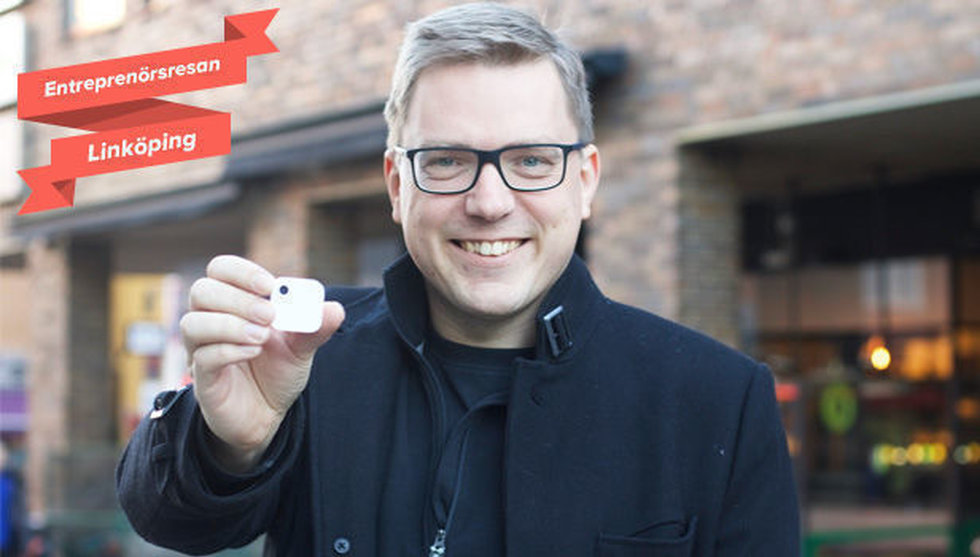
By 2021 the rule has acquired a stick. Once the idea is chosen, "You need to tell everyone so that, that if it's nothing else, it's the shame of failure or the shame of giving up." that keeps you in line when nothing else does. ▶ 42:09 And it has a counter-intuitive twist: the commitment has to be visible as risk, not as confidence. "If you talk from your heart, people will want to help you." But "in order to get people's help, you actually need to show vulnerability", because a founder who narrates everything going to plan is told to call back when it's real. Going round Linköping with a 3D-printed prototype, telling people he was starting a camera company with manufacturing in Asia, he says, "I realized that I have to believe in it to achieve it." The reaction he wanted, and got: "holy shit, he's actually doing this. He's jumping off the cliff. I need to help him right now in order for this to work out." ▶ 36:49 The 2014 version of the same point is about validation: "Varje påstående måste valideras av någonting man har gjort." (Every claim must be validated by something you have done.) "Istället för att bara säga vi är Born Global, vi ska gå internationellt från start. Så är det så otroligt mycket starkare att säga vår PR-byrå sitter i USA. För att då är det handling och inte bara ord." (Instead of just saying we're born global, it's so much stronger to say our PR agency is in the US, because then it's action, not words.) ▶ 55:21
A signature nobody had approved
The first documented instance is from Twingly's first winter. The biggest newspaper trade fair was in Vienna and had room for only eight exhibitors: "Du fick bara plats åtta utställare där. Vi hade roffat åt oss en av de platserna med hjälp av lite Almi-pengar." (There was space for only eight exhibitors. We had grabbed one of them with a little Almi money.) ▶ 26:56 How the slot was grabbed is the point: "Jag fick göra en liten kupp där." (I had to pull a small coup.) The organisers needed an early answer, and "jag hade inte riktigt hunnit sälja in det klart till mina medgrundare så jag signade på där utan att berätta det för någon annan" (I hadn't quite finished selling it to my co-founders, so I signed without telling anyone). He pitched it to them afterwards. "Det var ju tur att de andra gick med på det och tyckte att det var en bra strategi." (It was lucky the others went along with it and thought it was a good strategy.) ▶ 28:31
Having committed to a booth they could not afford to fly to, the four founders improvised the rest: "Och packade den full med utställningssaker. Och oss fyra grundare. Niklas, Björn, Figge och jag. Och åkte 180 mil ner genom Europa på autobahn. Genom snöglopp." (packed a rented van full of exhibition kit, the four of us founders, Niklas, Björn, Figge and me, and drove 1,800 kilometres down through Europe on the autobahn, through sleet). ▶ 26:56 Social media was the topic of the year and "Vi var den enda utställaren som hade någonting med det att göra. Så vi fick väldigt mycket uppmärksamhet." (We were the only exhibitor with anything to do with it, so we got a lot of attention.) The trip produced the first international customers, Helsingin Sanomat and the Sunday Times in South Africa, and, as he tells it, made Dagens Nyheter and Svenska Dagbladet see a bigger supplier than Twingly actually was. ▶ 27:47 ▶ 26:30 The same reflex sent two unpaid thesis students to London to promote the screensaver, which is how Twingly found its first investor; that story lives in Luck is having all your tentacles out. ▶ 19:47
The Vienna signature also fixed a principle. Twingly was to be born global, and Narrative repeated it more literally: "Nu är USA vår hemmamarknad. Det är där vi har fokus." (Now the US is our home market. That's where our focus is.) ▶ 29:24 ▶ 6:24 The argument for that is made in full under Born global.
Suitcases in an investor's office
Narrative's seed round was the rule applied to money. The founders had gone full time in March 2012, two months before any venture money arrived, ▶ 1:55 and when the first meeting at Passion Capital in London came up almost by accident, they could not afford a same-day return flight. Asked why they had stayed overnight, "Så då sa vi någonting om att vi hade ett par andra möten igår." (so we said something about having a couple of other meetings yesterday). The implied competition produced an offer straight after the meeting and a term sheet the next week. ▶ 10:06 ▶ 10:31 In the 2015 telling the answer was a refusal, 'det kan jag tyvärr inte svara på', which the investors read the same way; that time he also mentions the six Passion-backed founders he had asked to vouch for him. Breakit ↗ They took the first offer. "Man vet ju inte alls vad man missar. Men vi satsade på hastighet" (you have no idea what you're missing, but we bet on speed). ▶ 10:56 Passion's €500,000 sat on a staircase he had already drawn: Twingly salary, a 200,000-kronor Innovationsbron grant, a 300,000-kronor county loan, seed, then Kickstarter, each step justifying the next. ▶ 29:15
1.3 million kronor before day one
The most expensive version of committing early was design. The 300,000-kronor grant went entirely to industrial designers, and then "we paid almost a million in that that we didn't have yet" through a revenue-share deal. "before even starting work full-time myself, I had spent 1.3 million kronor only on design". His defence is that hardware takes too long to show any other way: "There was no other way to show our vision than to invest in the design", and "within 9 months we had raised 10 million kronor from the product of that design". ▶ 33:41
The same posture recruited the team. Building Narrative's first group, he resolved to talk only to the best person in each field, and "actually half the people I talked to quit their jobs to come to work for me when all I had was a PowerPoint." ▶ 23:27 The co-founders assembled in the autumn and winter of 2011, Oskar Kalmaru from the video service Bubblare and Björn from Axis, before there was a company to join. ▶ 43:56
What the rule cost
Martin is candid that the same instinct set Narrative's strategy. "Vi satsade väldigt stort och spände bågen högt. Och det gör att folk tror på en och vill vara med och hjälpa en framåt." (We bet very big and drew the bow tight. And that makes people believe in you and want to help you forward.) ▶ 11:47 He frames it as a reaction to Twingly, where the founders took 10 million kronor and asked "Hur ska vi få de här pengarna att räcka så länge som möjligt?" (how do we make this money last as long as possible?), a caution that led to years of chewing along rather than growing. ▶ 12:55
The bill came in 2016. "I backspegeln inser jag att vi spände bågen lite för högt." (In hindsight I realise we drew the bow a little too tight.) Breakit ↗ The mechanism he blames is the one that had worked so well on people: investors who believed hard enough to say "we finance you. Just make the product as affordable" as possible, engineers who wanted every magical component, and a CEO who did not hold the margin against either. "I was not strong enough, or I didn't have the strong vision". ▶ 18:09 When wearables went cold, "the market sort of told us that we were in the wrong stage at the wrong time". ▶ 17:44 The full accounting is in Failure & resilience.
What keeps the rule alive despite that is the one time he broke it. In 2024 he abandoned a voice-AI project after a demo-filled trip to San Francisco convinced him the field had moved on. As he tells co-host Rasmus Adler Wahlberg: "I was probably something like 2 months away from a beta when I made a pivot. And that's something that I really regret doing now". ▶ 14:19 In hindsight, "I should just stay home and finish my own code." ▶ 14:45 Over-commitment cost him a company; under-commitment cost him the project he still thinks about. He seems to have decided which regret he prefers.
Worth remembering
- Believe it will be real and say so; there is no other way to make it real. ▶ 72:21
- Tell everyone, so that the shame of giving up holds you when nothing else does. ▶ 42:09
- Show the jump, not the confidence: people help someone who is visibly off the cliff. ▶ 36:49
- Validate claims with actions: a PR agency in the US beats the phrase born global. ▶ 55:21
- The bow can be drawn too tight; hold the margin even when believers tell you not to. Breakit ↗ ▶ 18:09