
An honest pitch beats fake openness
One of the rules Martin says he paid for is short: if you have already decided, say so. Pretending a decision is open when it is not costs more than announcing it, because the people you invited to decide will notice, and will not believe your next invitation either. He learned it at Twingly around 2008, at an offsite on Gotland he still cannot describe without blushing. The rule has a mirror image (no frame at all fails just as surely), a security corollary (a flat, transparent organisation is hard to defraud), and a positive form he found later in the Borderland community and in how Multiply was built.
Gotland, 2008: faking a clean slate
The setting was, by his own account, perfect. Twingly had a basic product bringing in revenue and a multi-year development process on top of it. ▶ 8:33 Martin and the product manager, Anton (the first employee, the fifth person in the company ▶ 8:32), had spent months on an idea about communication inside organisations, at a time when Yammer was, in Martin's phrase, “a corporate Twitter.” ▶ 8:59 ▶ 9:24 They took the team to an offsite on Gotland, at a hotel his co-founder then owned, “beautiful stone building on the countryside with the ocean just a kilometer's walk away”. The whole event was really good, he says, apart from one thing. ▶ 10:41
The one thing was the product session. Martin and Anton “came in with a very firm idea after months of work of what the solution should be”, and their way of building common ground was to try to steer a co-creation process toward it. ▶ 11:07 They opened the floor, and the team did what teams do when asked: “people had great ideas. And we just realized, oh shit, what do we do now?” ▶ 11:49 Fifteen years later the memory still produces a physical reaction: “Still to this day, I cannot talk about this without like having— my entire body is blushing in how shameful this is, that I just attempted to fake a co-creation workshop when a proper pitch would've done the job.” ▶ 12:14
The lesson is not that they should have been more open. It is that they should have been honest about being closed: pitch the product they had already formulated and talk from there, “instead of faking a clean slate.” ▶ 13:02 Real co-creation, in his formulation, means everybody brings everything they have, and “They should not bring an agenda to steer anyone else.” ▶ 13:02 A hidden agenda disqualifies you from the table. A declared one is just a pitch.
He also describes the honest recovery. Two hours into the two days, when he and Anton realised it was not going to work, they could have owned it to the whole team: “wow, we came into this with a completely wrong idea of what was going to happen. Can we just start over?” ▶ 19:12 They did not, and that is the part he treats as the actual mistake.
The mirror image, briefly
Rasmus Adler Wahlberg's story in the same episode is the inverse failure; Failure & resilience tells it in full. At Visa, his first company, he gave developers ownership of a blog CMS with no timebox or budget, watched them overbuild it under the motto “how hard can it be?”, and took the ownership back, which “basically means that the first ownership was not real.” ▶ 4:50 ▶ 8:24 Martin drew a frame and hid it; Rasmus drew none and later imposed one. Both conclude that when boundaries were wrong the leader has to say so and redraw them, so that “it doesn't become taking back ownership, it becomes clarifying ownership.” ▶ 20:39 Rasmus adds the stake: a CEO who announces co-creation and does not mean it has taught the team “people shouldn't really trust what I say after that.” ▶ 23:15
An honest frame is also a defence
The same principle showed up at Narrative in a form Martin did not design for. In 2014 or 2015, he says, a wave of attacks hit Swedish companies, including his: perpetrators made “dozens of calls into” the company asking who handled invoices, mapped the roles and lines of decision, then sent the controller an urgent spoofed email from Martin ordering a payment to a new bank account. ▶ 22:45 ▶ 23:10 It failed because the organisation was so flat that a large payment to a foreign account would never happen without the controller being clued in. ▶ 23:36 Rasmus's summary: one of the defences had been flatness itself, and resilient, antifragile organisations would become a live topic because of AI. ▶ 25:35 A structure everyone understands is one a stranger cannot impersonate.
He had applied the same instinct to hardware: the Clip was designed to be “both honest and subtle,” recognisably a camera rather than a spy device ▶ 20:21, after focus-group work on a camera “that doesn't look like it's hiding itself, but actually being honest with its purpose”. ▶ 15:09 See Privacy & surveillance.
Borderland: what trust looks like when the frame is visible
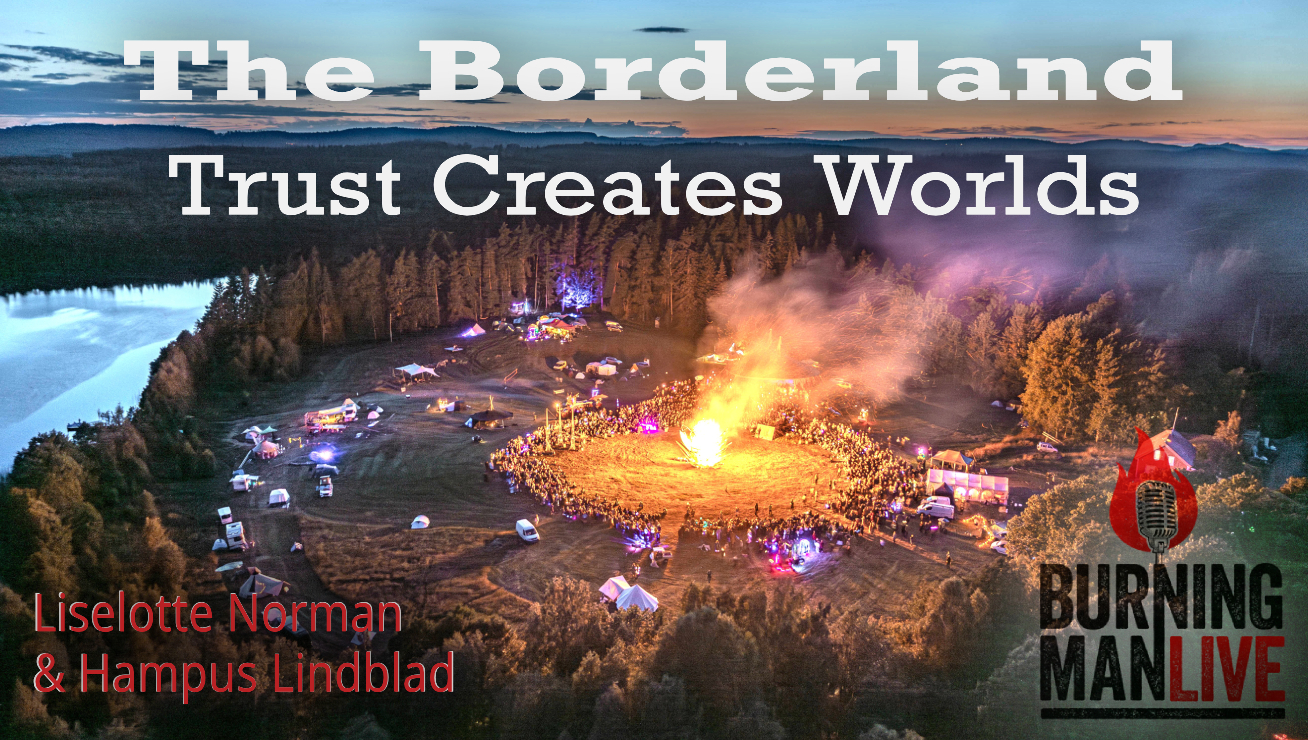
The positive version is the community Martin later helped give a permanent home at Alversjö. In a 2026 Burning Man podcast, Borderland organisers Hampus Lindblad and Liselotte Norman described how a festival of thousands runs with no one in charge. Norman explained the mechanism, a flat peer organisation run on advice processes: “If you want to do something, You run an advice process where you seek advice and input and different perspectives”, while the board mostly rules on exclusion cases. ▶ 10:48 ▶ 11:48 Not all 5,400 participants take part, she added; you have to know how the thing works first. ▶ 16:07 The community's own introduction calls it do-ocracy: “Power comes from action, not titles.” Borderland Talk ↗
Lindblad supplied the stress test. In 2018 the event lost its Danish site six weeks out. “We managed to actually find and sign all the contracts, get everything done, and move the whole event within a few weeks' time”, he said, and the method was the frame itself: “fully trusting the community, fully empowering decentralized teams” to scout and negotiate across Northern Europe, rather than pulling the crisis into a committee. Organisational researchers later studied it. ▶ 13:04 ▶ 13:27
He also told the story of a hidden frame. Borderland's funding began with a conventional art committee, a small group deciding where the limited money went, and “there was a reaction to that from the community”. The alternative was a Dreams platform where every member allocated their own credits to proposals, like a community Kickstarter. ▶ 19:29 ▶ 19:55 Forty developers from Israel's Midburn adopted the open-source tool and handed it back improved; a Swedish innovation-agency grant funded further work; it became CoBudget, now wired to Open Collective for direct reimbursements. ▶ 20:16 ▶ 21:09 That plumbing, Lindblad said, is part of why Borderland runs at this scale “without having anyone paid on staff”. ▶ 21:35 The committee was the Gotland move; the reaction built the honest frame instead.
Trust grows inside a frame, not instead of one
The version practised at Multiply is smaller. Martin's description of working with a new collaborator, human or AI, is that the start is hands-on and conversational, and over time “the human or the AI becomes more and more autonomous”, which is itself the sign that trust has been allowed to evolve. ▶ 12:41 ▶ 13:07 Rasmus answered with a fresh example: a community manager they had just started working with, onboarded strictly (here is the content workflow, here is the podcast, product update every week), then iterated on. “I can already feel his autonomy increasing”, he said; fewer questions, more initiative, no less collaboration. ▶ 13:30 ▶ 13:56 The frame was explicit from day one; the autonomy grew inside it.
Rasmus says the same happened to him. In earlier companies he had been a strong lead on the what and the why; at Multiply the high-level vision held but what they were building evolved, and “a lot of it came from you and Henrik and Oskar”. ▶ 11:13 ▶ 12:05 He borrows Frederic Laloux's term, evolutionary purpose, for an organisation where even the purpose is up for question. ▶ 12:31 The practical tool was written principles, which Rasmus calls a boundary: if something good already exists, use it rather than build it. ▶ 21:23 It is the CMS lesson written down before the next CMS. See Leadership & organization and AI co-creation.
Worth remembering
- If you have already decided, pitch it. Gotland failed because Martin and Anton faked a blank slate when a proper pitch would have done the job. ▶ 12:14 ▶ 13:02
- Own the wrong frame the moment you see it. The honest recovery was to stop after two hours and ask the team to start over. ▶ 19:12 ▶ 12:14
- No frame is as dishonest as a hidden one. Rasmus's CMS delegation with no boundaries had to be revoked, which proved the ownership was never real. ▶ 8:24
- Transparency is a security property. A flat Narrative defeated a carefully researched spoof-email fraud because nobody could pay out large sums without knowing what was going on. ▶ 23:36
- Trust scales when the frame is public. Borderland moved a festival in six weeks and replaced an art committee with a member-run budget by putting decisions in members' hands. ▶ 13:27 ▶ 19:29