



Hardware & manufacturing
Martin's hardware philosophy was forged in one project: the Memoto camera, later renamed Narrative Clip, his first venture into physical product after a career in software (▶ 1:32). Small components, laser-drilled circuit boards, a supplier who installed a chip backwards, a GPS antenna that had to be redesigned twice, an "honest but subtle" design brief refined through fifty hours of user interviews — hardware taught him that almost everything takes a year to eighteen months, that problems always happen so you need direct access to your factory, and that a device shipped with flaws is judged far more harshly than software ever is. That experience also shaped how he thinks about infrastructure more broadly: the same instinct that pushed him to bake global scalability into Twingly's database architecture from day one runs through his more recent thinking on AI chips, world models, and why the Narrative Clip's failure now looks like it happened a decade too early.
Honest, subtle, and worth investing in: the design philosophy
Good hardware design has to resolve a tension between honesty and subtlety. Building Memoto, Martin's team ran fifty hours of user interviews and iterative prototyping to land on a rule: the device had to look recognizably like a camera — "honest," not a disguised spy device — while staying unobtrusive enough not to distract anyone around it. A third-eye lens placement failed because it read as dishonest about where the "eye" was; a metallic lens ring borrowed from mobile phones succeeded because it signaled "camera" instantly (▶ 20:21, ▶ 19:56). Journalists picked up on the difference: articles comparing Narrative to Google Glass credited Narrative with conveying that same honesty about its purpose in a way Glass never managed (▶ 15:35).
Design has an unusually high return on investment — Martin says tenfold to a hundredfold. He puts a number on it: a 300,000-kronor design grant from Innovations Systemet, plus close to a million kronor paid to industrial designers on a revenue-share he couldn't yet afford, bought Narrative a design polished enough to raise 10 million kronor within nine months — before the product was fully built. Design, in his framing, is simultaneously functional and storytelling: it communicates the vision faster than a working prototype could (▶ 31:57, ▶ 33:14).
Hardware is the easy part to copy — the real differentiation is what you build around it. Martin has argued at different points that Memoto's edge lay in software and image analysis rather than the camera itself, since "the hardware is actually the easiest thing to replicate" (▶ 15:14) — and separately, that a startup's daily operational know-how is what can't be stolen in a single meeting, a point he made after Snapchat's acquisition talks with Narrative fell through and Snapchat later announced its own, similarly-conceived wearable camera hardware (▶ Breakit ↗). He also frames devices as more than function: buying a Fitbit, even though a phone can do the same tracking, changes how you see yourself — "you're thinking about yourself as changing your lifestyle to something better" (▶ 29:07).
Building the Narrative Clip: idea to shipped hardware
Origins
Martin's idea for a wearable camera came from watching cameras shrink as mobile-phone technology matured (▶ 1:36). He'd initially dismissed the concept, assuming a camera would need to be miniaturized down to 5×5 cm — implausible at the time — until he came across an SD card with an embedded camera and reconsidered (▶ 38:50). The very first prototype, built on an off-the-shelf evaluation kit, was a 4×4-decimeter (roughly 16×16 inch) box before any miniaturization work began (▶ 53:46).
Engineering under startup constraints
Component choice for a small hardware startup is driven less by the best available spec than by what you can actually get and get supported. Martin illustrates this with Memoto's own trade-offs: a specialized Ambarella video processor (chosen for pipeline quality) paired with a generic Broadcom module for Wi-Fi/Bluetooth (chosen for support), and a camera sensor that was already five years old when design started in 2012 and 6.5 years old by launch — simply because that was what a startup at their size could access (▶ 37:31, ▶ 37:06, ▶ 37:45).
Fitting a functional camera into a 36×36×9 mm shell required real engineering depth: an 8-layer High-Density-Interconnect PCB with laser-drilled blind and buried vias, needed to route fine-pitch BGA components spaced as little as 0.5 mm apart (▶ Kickstarter ↗). The prototype's mechanical design — a production-ready, weather-protected casing — took two engineers and one industrial designer four months (▶ Kickstarter ↗), and the team commissioned outside expert reviews of the PCB from specialists in power management (the Anoto pen's creator), build quality (a Mutewatch engineer), and GPS (▶ Kickstarter ↗). GPS integration was one of the hardest problems: a 2×3 mm PCB-based antenna failed outright due to component density, forcing Swedish antenna specialists to redesign it as a wire antenna that finally worked (▶ SlashGear ↗). Other deliberate design calls: a 70-degree lens angle chosen to match a mobile-phone's field of view rather than a wider, more distorted lens (▶ Kickstarter ↗); GPS tagging deferred to cloud processing, not done on-device, to save battery (▶ Engadget ↗); and weather protection that stopped short of full waterproofing, addressed instead with an optional separate case (▶ Kickstarter ↗). Rather than build every feature into the core camera, Memoto chose to keep it simple and sell accessories — including a Wi-Fi dock complex enough to function almost as its own standalone computer, with a processor, Wi-Fi chip, RAM, and firmware flash (▶ Kickstarter ↗).
Manufacturing & supply chain
Designed in Sweden, made in Taiwan (▶ 2:09) — Memoto planned the move from Swedish prototype assembly to Taiwanese manufacturing early, deliberately following the supply chain of the Swedish watch brand Mutewatch (same manufacturer, packaging supplier, quality-control firm, and logistics partners) so they could learn from Mutewatch's mistakes rather than repeat them (▶ WSJ ↗). Capacity ramped in stages — five units at a time in Sweden, then a plan to scale to 50 and eventually 1,000 (▶ WSJ ↗) — and even so, shipping slipped by over a month, from late February to early April 2013, after a supplier installed a chip incorrectly (▶ Forbes ↗). Kickstarter funding didn't cover full production costs on its own; the campaign was necessary to actually complete manufacturing (▶ Kickstarter ↗). Years later, in 2016, Narrative considered moving manufacturing back from Taiwan to Sweden to keep production and development closer together (▶ Affärsliv ↗).
Crowdfunding does double duty: it proves demand and tells you exactly how many units to build. Martin has said a campaign reveals whether the right production run is 300, 3,000, or 30,000 units, while simultaneously financing that run (▶ 6:34) — and he later advised other hardware founders on Kickstarter prep via Skype, sorting their problems into setup, underperforming campaigns, and post-campaign delivery (▶ 12:38). He's pointed to Narrative's own transparency about pre-campaign supply-chain work — something he says many Kickstarter projects skip — as part of why it worked (▶ 10:09).
Clip 1 → Clip 2: iterating on the hardware
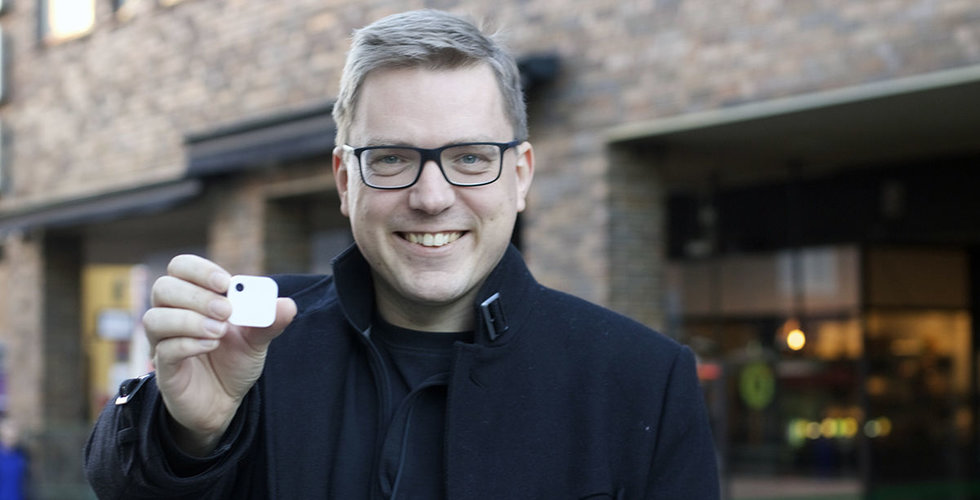
The first Narrative Clip was a minimalist device about half the size of a business card: a 5MP camera, GPS, accelerometer, magnetometer, and 8GB of storage, with no physical buttons — just a touch-sensitive front you'd double-tap to trigger a photo or check battery life (▶ I Started Something ↗). A metallic clip on the back let it grip clothing, pockets, or hats (▶ I Started Something ↗), and the cloud platform auto-corrected photo rotation to level the horizon regardless of the angle the camera was worn at (▶ I Started Something ↗). It had no Bluetooth or Wi-Fi — data moved only via a docking station that uploaded photos roughly every two days, requiring users to dock and recharge on a schedule (▶ 4:45, ▶ 9:36) — a real compromise against Martin's original vision of unlimited battery life and unlimited storage (▶ 3:23). It also had a documented design flaw: because it hung at a fixed angle on clothing, it pointed downward while sitting and upward while standing, missing what was directly in front of the wearer in either position (▶ 5:03).
Clip 2 addressed several of these directly: a flexible, replaceable mount for better wearability across clothing types, designed with sports use and Swedish winter conditions (thick jackets) explicitly in mind (▶ 0:27, ▶ 2:00); a wider-angle lens and higher-definition sensor (▶ 4:00); more customizable mounting accessories (▶ 4:00); and roughly 30 hours of continuous battery life, aimed at lasting a full day at conferences and events (▶ 7:59). By 2022, later Narrative hardware let users trade off between up to two weeks of battery life or higher-quality video capture, depending on what they wanted from the device (▶ 25:04).
Why it struggled
Martin's own retrospective separates the concept from the execution: Narrative ultimately failed because of production problems, not because the idea was wrong (▶ 2:59) — though he's also named battery life and weak user adoption as the concrete failure points of the first Clip specifically (▶ 2:11). By 2024 he'd reframed the whole project's timing: the Narrative Clip launched roughly a decade too early, before AI had the capability to do anything meaningful with a day's worth of continuous photos — a trial he says he'd love to run now with GPT-4 (▶ 16:21, ▶ 16:39).
Wearable technology, defined by the R&D problem it creates
Martin's working definition of "wearable technology" isn't about the tech — it's about the central engineering problem. "One of your main R&D challenges is to figure out how the heck are people actually going to wear this thing," he's said, twice, in near-identical language: if attachment, comfort, and social acceptance aren't the thing you're iterating on hardest, you're probably not really building wearable tech (▶ 10:24). He traces the same conclusion to a Toronto wearables panel he attended: the field's fundamental challenge is finding form factors that aren't too intrusive and don't require habits too hard to adopt (▶ 2:08). He cites the Sony Walkman as the historical precedent for how much organizational courage this can take — Sony reportedly faced heavy internal resistance to the idea that people would wear wired earbuds in public at all (▶ 2:35).
Two form-factor predictions follow from this. First, glasses are an excellent form factor once the hardware is light enough — Martin argues from his own life (wallet merged into his phone, no more separate keys) that people already resent carrying extra objects, so a form factor that eliminates that friction wins (▶ 22:34; he repeated the same bullishness on AR glasses in 2024). Second, cameras and screens are the only wearables that can't eventually be absorbed into the smartphone — fitness trackers and health sensors are already migrating into phones, but a wearable camera or an eye-projected display need form factors a pocketable phone can't provide (▶ SlashGear ↗).
Martin also draws on "service design" — a growing academic field, in his telling, that looks at a product's entire user experience rather than treating graphic design, industrial design, and product development as separate disciplines (▶ 7:13, ▶ 7:38) — as the intellectual frame behind Narrative's hardware decisions.
Scaling infrastructure: lessons from Twingly
Martin's hardware instincts show up just as clearly in server architecture. At Twingly, he argued that global scalability has to be designed in from day one, not retrofitted — once a database holds 100+ million rows, you can no longer add indexes or change schema without downtime the business can't afford, so Twingly deliberately avoided any early technical shortcut (like assuming a limited geographic scope) that would trap them later (▶ 7:36).
The concrete solution was horizontal scaling via hash sharding: rather than one large MSSQL server (50–70k kr), Twingly partitioned data across 128 tables spread over cheap Dell "pizza box" servers (6k kr each), letting them double capacity by adding four more machines with no downtime — at the cost of more complex queries, a trade-off Martin judged worth making (▶ 47:09). He also describes offloading infrastructure risk onto third-party clouds as a way to change your scaling curve entirely: instead of serving blog widgets from their own servers, Twingly generated JSON and JavaScript once per update and pushed it to Amazon S3, so newspaper traffic spikes were absorbed by S3 rather than Twingly's own load — decoupling server load from customer count altogether, "the opposite of most SaaS scaling curves" (▶ 1:46:30).
Not every company needs this. Martin points to FriendFeed as the counter-example: they never built horizontal scaling because commodity memory prices halved roughly as fast as their user base doubled, making vertical scaling (bigger machines) cost-neutral — and they were acquired before that trend ran out (▶ 15:01). Separately, he's criticized traditional relational databases for forcing an upfront, rigid schema that later evolution requires risky "migration weekend" scripts to change — a frustration that pushed him toward more flexible, schema-evolving data stores in his later software work (▶ 14:46).
The hardware startup playbook
Distilled from years of building and later advising hardware founders, Martin's rules of thumb:
- Budget a year to eighteen months for almost anything. "If you're asking yourself how long is this going to take, the answer is always a year to a year and a half. Almost whatever you're talking about" (▶ 19:33).
- Keep the supply chain simple, with direct factory access. Problems will happen; layers of intermediaries just slow down solving them (▶ 22:24).
- Get the minimum viable product right, then iterate on real feedback rather than over-engineering before shipping — his advice to new hardware founders is to get to market quickly and cheaply first (▶ Rude Baguette ↗). First-generation hardware startups, he notes, face a compounding version of this problem: limited funding for components, poor supplier access, and no user feedback yet to iterate on (▶ Rude Baguette ↗) — success requires solid production partnerships, sufficient funding, and a cohesive team all at once (▶ Rude Baguette ↗).
- Stage hardware rollouts deliberately, unlike software. A hardware recall is expensive and visible in a way a software patch isn't, so Martin's plan for Narrative Clip's launch was to ship a small batch first, watch how the backend and camera performed, then ramp based on what was learned (▶ SlashGear ↗).
AI's new relationship with hardware
Martin's more recent thinking treats "hardware" and "AI" as increasingly entangled. He argues that world models — internal representations of physical reality — are becoming essential to AI systems that act in the world, pointing to LLMs, Midjourney, Sora, and the Figure humanoid robot (which had to infer where plates belong in a dishwasher) as evidence the same underlying capability is emerging across every modality (▶ 10:38). He's also bullish that multimodal AI makes AR and wearable computing practically inevitable, citing live examples like photographing a Thai menu and getting instant translation, or using a Vision Pro to read a whiteboard of code — proof, to him, that "sci-fi" wearable visions are close, even if rollout takes years (▶ 9:08).
On the compute side, he's tracked specialized AI processors as a possible challenge to Nvidia's dominance — putting a transformer directly into a chip, he notes, can deliver roughly 50x the performance of a generic GPU, and a maturing, heavily-invested-in library like Hugging Face's transformers makes that kind of hardware embedding increasingly plausible (▶ 21:51, ▶ 22:20). But he's equally clear that compute economics impose hard limits on what AI can be commercially deployed into: AI-driven game dialogue is technically feasible, but running inference costs roughly $1/hour of gameplay against a typical $9–39 lifetime revenue per Steam player, leaving no margin — a problem he thinks might only be solved with small, game-specific models rather than general-purpose ones (▶ 13:35, ▶ 14:25).
That same economic lens changed how he now talks about his own old hardware: the Narrative Clip's IP has gone from failed consumer product to potential AI training asset. No device has matched it since, he says, and an 8-year-old Clip 2 dataset is now valuable precisely because of what AI can do with it — he's floated reviving production for $2.5 million and a 10,000-unit minimum run, with the IP still held by his former CTO (▶ 27:28).
Worth remembering
- Martin genuinely loves working with physical products — "it's really amazing to work with a physical product" — and says hardware taught him something new almost every day, in a way his prior software career hadn't (▶ 1:48, ▶ 2:09). He's just as blunt about the cost: "how much trial and error it is to work with hardware," and how much can simply go wrong (▶ 2:22).
- Memoto positioned itself against GoPro and Looxcie by design: simple, elegant lifelogging rather than HD action-sports recording (▶ Fstoppers ↗).
- "The best camera is the one you have with you" — Martin has said his own camera use shifted from SLRs to phone and Narrative Clip as those improved, leaving his SLR lenses unused (▶ 6:19, ▶ 5:52); he sees phones and wearable cameras as complementary rather than competing — phones for conscious, composed shots, wearables for what you'd otherwise miss (▶ 6:54).
- The automaticity of capture is the whole point. Speakers in the Lifeloggers documentary — Martin included — praise devices you "wear and forget," contrasting them with the friction of manually logging life in an Excel sheet or a scrapbook; automation, in this framing, is what makes lifelogging viable at all (▶ 16:31).
- Continuous wearable recording runs into physical limits that go beyond battery: terabytes of compressed video per person per year, and cell networks that throttle heavy users long before always-on capture becomes practical (▶ 6:24, ▶ 5:59).
- Martin distinguishes autonomous AI agents from manufacturing robots on a specific axis: robots follow strict, predetermined instructions, while agents write their own task lists and choose methods unpredictably — a distinction he draws directly from his hardware background (▶ 4:29).
Related: Narrative · Twingly · Narrative Clip 1 · Narrative Clip 2 · Memory & photography · Growth strategy & risk