

Elysium
Elysium is a participatory immersive theatre production staged in central Stockholm in an ex-retail unit dressed as a luxury "transcendence clinic" run by the Greek god of death. There is no stage and no auditorium — the audience checks in as clients, hands over their phones, puts on a robe, and spends two and a half hours free-roaming a mythological beauty clinic that doubles as a critique of the wellness industry and the "broken world" it promises to fix elysiumlife.se ↗, Research ↗.
Mathias Gullbrandson, Elysium's director and artistic leader ("regissör och konstnärlig ledare"), was instrumental to the project: he created the show together with the creative team elysiumlife.se ↗, Research ↗. A veteran of Swedish immersive and site-specific performance, Gullbrandson built the framework that makes Elysium work: structured enough to carry a story, open enough that every participant walks their own route through the clinic, with four actors improvising against whoever is in front of them Research ↗. Gullbrandson is also the long-standing thread linking Elysium to the rest of Martin's world: he was an initiator of The Borderland and instrumental in the founding of Alversjö Natur. Full profile on People & Partners.
Martin Källström, working through his company Be Here Now, is credited on the production as "AI-arkitekt & Digitalt Gränssnitt" — AI architect and digital interface — the team member responsible for the show's pre-visit "digital conversation" with the character Hades and, per outside research, the technical layer behind how the clinic personalizes itself to each visitor elysiumlife.se ↗.
Origin: Belinda Retourné's "planet B" thought experiment
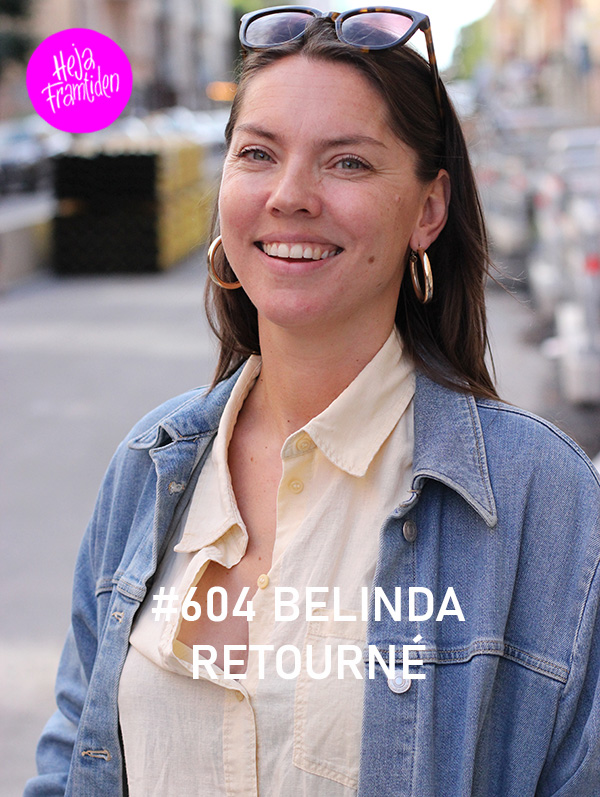
On the Swedish podcast Heja Framtiden (episode #604, published September 23, 2025 — roughly five weeks before Elysium's premiere), producer Belinda Retourné described the show's actual origin: not a commission or a business plan, but a moment of exhaustion. After roughly a decade writing sustainability reports, corporate communications, and articles without seeing the engagement those facts should logically produce, she said she woke up one night overwhelmed by a familiar fatigue — the sense that nothing can really change because of politics, economics, or entrenched norms ▶ 6:39, Heja Framtiden ↗. Rather than argue against that fatalism, she leaned into it: "men kan vi inte bara låtsas då? Kan vi inte bara låtsas att det går? Så det var ju upptakten till [Elysium], att tänk om vi faktiskt hittade en annan planet, planet B" — but can't we just pretend, then? Can't we just pretend it works? That was the beginning of Elysium: what if we actually found another planet, planet B — untouched, empty, free of every system, institution, or structure humanity has built ▶ 7:34.
She was initially unsure what form the idea would even take: "Jag hade ingen aning om vad det här skulle ta för form. Jag tänkte ganska länge, är det här ett live? Är det ett escape room?" — she had no idea what shape it would take, wondering for a long time whether it would be a live show or an escape room — before assembling a team of artists who shaped it into the immersive theatre piece it became ▶ 9:21. The result, as she described it on the podcast, is a play set in a beauty clinic run by Hades, god of death, offering humanity the choice of leaving Earth altogether ▶ 9:46.
Two theses run through her account of why the show works the way it does. First, that reaching people on sustainability requires speaking to feeling, not just supplying more data: "det räcker inte med data och siffror" — data and numbers alone aren't enough, at least not in the rooms she moves in — a register she says needs to speak to "hjärtan och själar" (hearts and souls), not just the brain and reason ▶ 13:32. Second, that Elysium functions as an imagination sandbox: temporarily raising the ceiling of what feels achievable gives participants a felt sense of agency — "komma ut med en känsla, alltså en ökad känsla av agens, att man kan påverka, att man är kreativ" — coming out with a feeling, an increased sense of agency, that you can have an impact, that you are creative — which she hopes they carry back into their own workplace or housing association, not just an experience that ends when the show does ▶ 22:28.
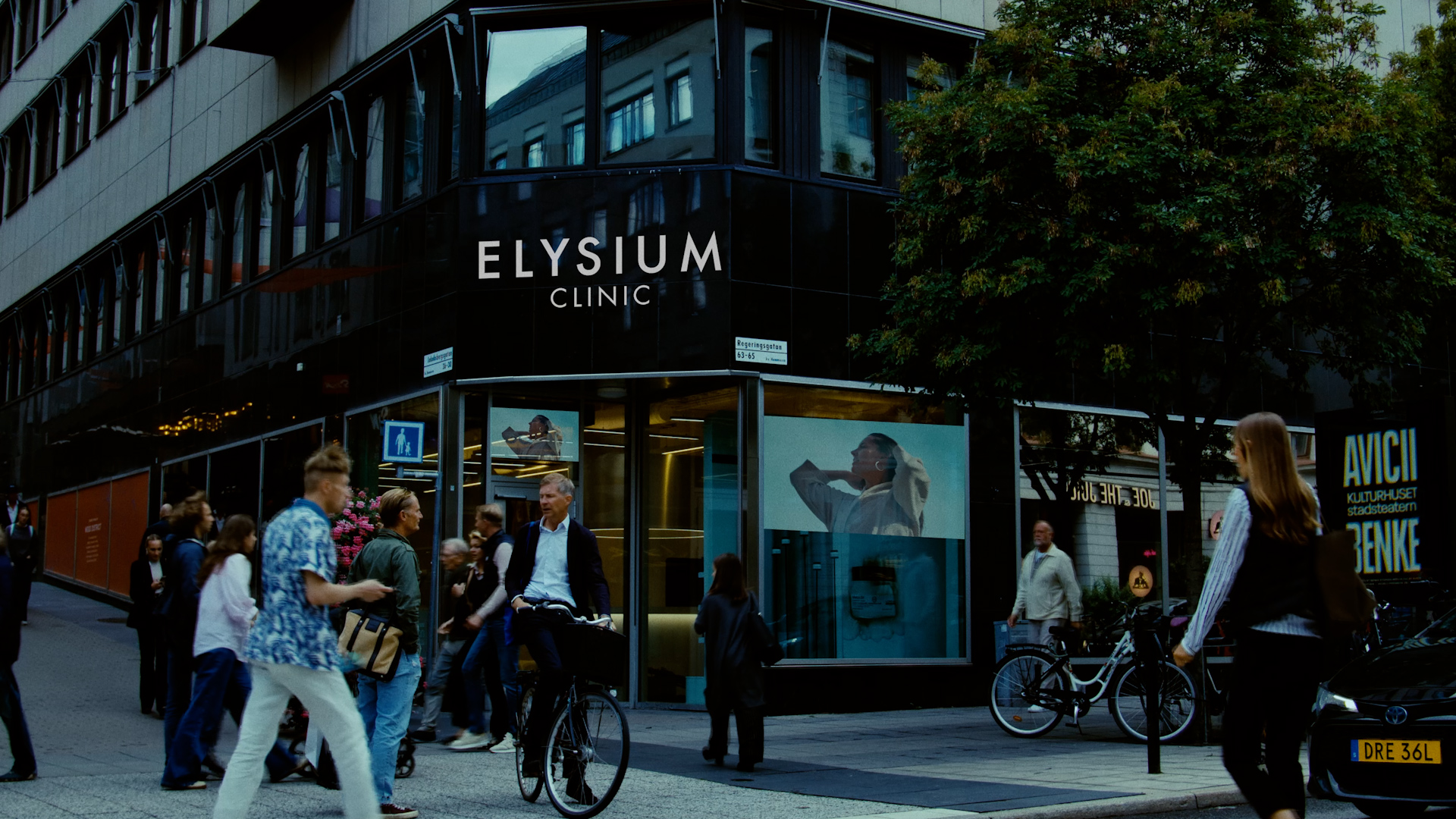
The design follows directly from that thesis: there is deliberately no audience. "det finns ingen publik... Det finns liksom ingen gräns mellan scen och deltagare" — there is no audience; there is simply no boundary between stage and participant ▶ 10:21. The 650 m² venue at Regeringsgatan 63 — secured on loan from commercial landlord AMF Fastigheter, tucked behind NK next to the MOOD-gallerian — becomes a beauty salon built around a doubled premise: exploring "den lilla kroppen" (the small body, the self) alongside "den stora kroppen" (the big body, the planet) ▶ 10:52, ▶ 11:10. On the same episode, Belinda announced the premiere date and run length publicly, in this archive's earliest-dated source for it: "Första november har vi premiär och så kör vi i sex veckor ungefär" — premiere on November 1, running roughly six weeks ▶ 11:39 — and named the production's funding, a Kulturbryggan grant from Konstnärsnämnden under its "Konstnärlig förnyelse" (artistic renewal) programme ▶ 12:28. She closed the episode hoping the six-week Stockholm run would be only the first leg of a longer life for the show — "kanske blir en Sverigeturné," maybe a Sweden tour — and pointed listeners to elysiumlife.se for tickets ▶ 47:31, ▶ 47:13.
Note on a transcription artifact: the podcast's auto-generated transcript renders the artistic director's name as "Mattias Skuldbransson" ▶ 11:49 — almost certainly an ASR mishearing of Mathias Gullbrandson, the name used throughout Elysium's own official materials elsewhere on this page.
The production: a clinic for transcendence
Elysium's premise is a mythological beauty clinic, "Elysium Clinic," whose founder and CEO is Hades — recast as a charismatic wellness entrepreneur rather than a subterranean god. The official framing: "Elysium är en deltagarbaserad föreställning om ideal, möjligheter och personliga val. Det finns ingen uppdelning mellan scen och salong och som publik deltar du i den värld som byggts upp" — Elysium is a participatory performance about ideals, possibilities and personal choices, with no division between stage and auditorium; as audience you take part in the world that has been built elysiumlife.se ↗. The play "relates loosely to the Greek drama of when Hades abducts Persephone, which leads to winter" elysiumlife.se ↗ — the classical myth in which Demeter's grief over her stolen daughter starves the earth into winter is restaged as an allegory for ecological collapse, with Hades now selling "a passage to the life the earth promised — but never kept" from inside a shopping gallery elysiumlife.se ↗.
The production develops "immersiv, omslutande scenkonst" (immersive, all-encompassing performance) by exploring the space between written scenes, improvisation, performance, audience role-play, and "en digital värld/AI" — a digital world/AI elysiumlife.se ↗. The clinic's own marketing voice, delivered in-character as a letter signed by Hades, promises visitors love that never dies, recognition that never fades, and a life without limits if they walk through the door — copy the production itself frames not as escapism but as "en förverkligad dröm," a realized dream elysiumlife.se ↗.
An outside research compilation reads this staging as a deliberate satire: locating a "cathedral of modern consumerism" critique of greed and ecological collapse inside an actual luxury shopping gallery, so that a passer-by "might easily mistake the Elysium Clinic for a genuine, newly opened high-end medical spa" — turning the wellness industry's own aesthetic and rhetoric of bio-hacking, longevity, and self-optimization back on itself Research ↗. That reading is a secondary, AI-generated interpretation rather than a claim made by the production itself, and is flagged here as such.
Run, venue, and earlier editions
- Elysium is staged inside a roughly 650 m² former retail unit at Regeringsgatan 63, inside the MOOD-gallerian, directly behind Stockholm's NK department store — nearest transit Hötorget T-bana Research ↗, elysiumlife.se ↗, Visit Stockholm ↗.
- The 2025 run premiered November 1, 2025. The production's own "about" page and its home page both give the closing date as December 15, 2025 elysiumlife.se ↗, and an outside research report independently gives the same Nov 1–Dec 15 window Research ↗; the production's ticketing page on Understory instead states the run closes December 13 Understory ↗ — a minor discrepancy between the production's own sources left unresolved here.
- A single visit runs about 2.5 hours Understory ↗. Tickets are sold individually or for groups, with gift cards also offered, starting from 390 SEK per person elysiumlife.se ↗, Understory ↗. The experience carries strong sensory content, low lighting, and interactive/emotional themes, and is restricted to visitors 18 and over Understory ↗.
- Earlier editions ran in 2023 and 2024 Research ↗ — a research compilation cites official "anthem" singles by the artist HYPNØTIK ("Pandora's Box," an official 2023 Elysium anthem, and "Hades Is Here," released March 1, 2024, as the official 2024 anthem) as public confirmation of the prior runs, though the 2024 edition's exact venue, dates, and format could not otherwise be verified from public sources Research ↗.
- The production is funded primarily by Kulturbryggan, part of the state Konstnärsnämnden (Swedish Arts Grants Committee), under its programme for artistic renewal of theatre, and is supported by property owner AMF Fastigheter AB — the company behind the MOOD-gallerian elysiumlife.se ↗. A research report frames the AMF Fastigheter relationship as a mutually convenient arrangement: public arts funding absorbs the risk of an unproven AI-driven format, while the landlord turns a vacant central-Stockholm retail unit into a publicized cultural destination during the November–December shopping season Research ↗ — again, an outside interpretive reading rather than a claim by the production itself.
The visitor journey
The experience is staged across distinct phases, each designed, per the production, "för att säkerställa din trygghet och komfort genom hela processen" — to ensure safety and comfort throughout elysiumlife.se ↗:
- Booking. Tickets are bought for individuals or groups via the Understory platform, with gift cards available elysiumlife.se ↗.
- The digital pre-interview. Before the physical visit, participants have a scheduled "digitalt samtal" — digital conversation — with the clinic's founder, Hades, described as intended to "förstå vad just du längtar efter och vill förändra" — to understand what the visitor longs for and wants to change elysiumlife.se ↗, Research ↗.
- The threshold. On arrival, visitors surrender personal belongings, including their phones, held in safekeeping for the duration; photography is prohibited throughout Understory ↗, elysiumlife.se ↗. Each visitor is issued a soft robe to wear over their own clothes, plus slippers, before being invited into the clinic elysiumlife.se ↗.
- Free-roam exploration. For the remaining roughly two hours, participants move freely through the 650 m² space, gain access to a personal account, health declaration, and avatar, interact with the cast and the clinic's "offerings," and take home a journal at the end Understory ↗, elysiumlife.se ↗.
Marketing: the Hermes and Persefone trailers
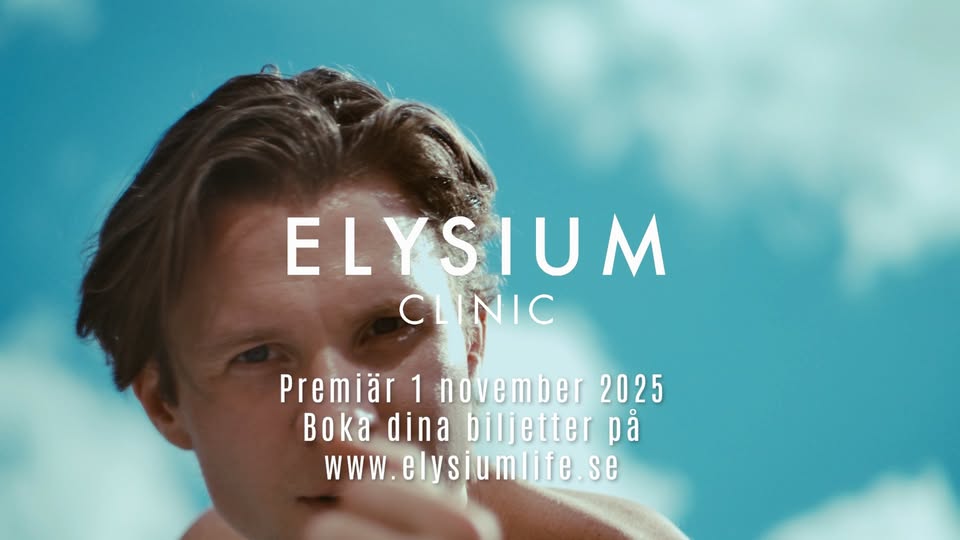
In the weeks before the November premiere, the production released short in-character promotional videos rather than conventional making-of trailers, staying inside the Elysium Clinic fiction throughout. A 39-second trailer posted September 10, 2025 opens: "Välkomna till Elysium Clinic. En nyöppnad skönhetssalong mitt i Stockholm som presenteras av dödsguden Hades" — welcome to Elysium Clinic, a newly opened beauty salon in the middle of Stockholm, presented by the death god Hades — framing the concept as "revolutionerande" (revolutionary) and promising customers the chance to explore what they dream of and "införliva dina drömmar," incorporate their dreams into reality ▶ 0:01, ▶ 0:26.
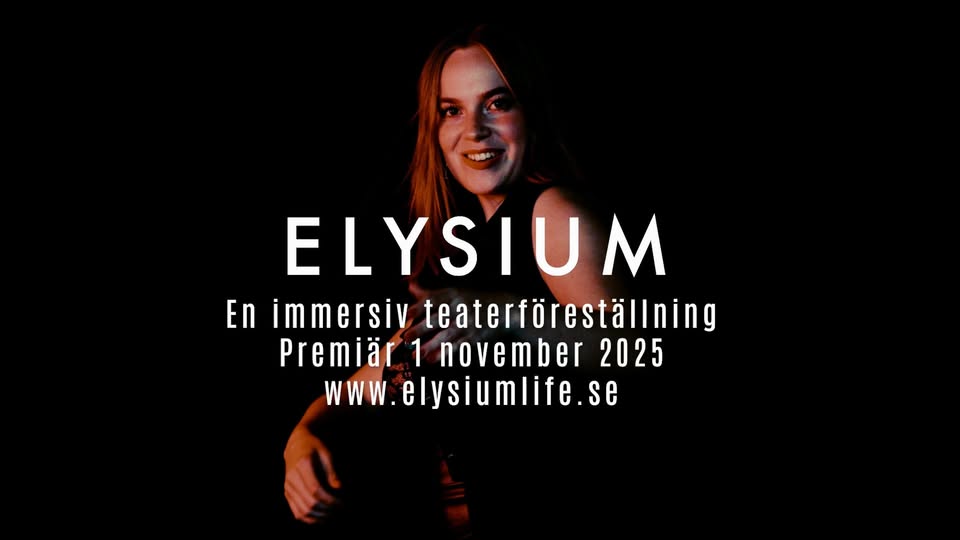
A second, 32-second video released in October 2025 shifts to a monologue delivered by the character Persefone, staying fully in character: "Jag är inte som alla andra. Jag delar verkligen hans visioner. Och hur han tänker. Inte bara med Elysium, utan med allt" — I'm not like everyone else. I really share his visions, and how he thinks — not just about Elysium, but about everything ▶ 0:03. Both videos market the show entirely through its fiction, with no direct appearance by the real creative team, cast credits, or behind-the-scenes framing — consistent with the production's overall "no division between stage and audience" premise extending into its own marketing.
Martin's role: AI architect and the surveillance question
Martin is credited on Elysium's official team page as "Martin Källström — AI-arkitekt & Digitalt Gränssnitt" elysiumlife.se ↗. The production's own public description of the AI/digital layer is limited to the pre-visit "digital conversation" with Hades; beyond that, neither elysiumlife.se nor the production's ticketing page publicly documents how the system works technically elysiumlife.se ↗.
Two independent AI-generated research compilations go further, drawing an explicit interpretive line between this role and Martin's earlier company Narrative — a connection worth flagging clearly as their reading, not a claim made by Elysium's own materials. Per one such compilation, the data gathered in the pre-interview "is undoubtedly fed into an AI system designed by Källström," which during the live show "could dynamically alter the digital interfaces within the clinic, trigger highly personalized soundscapes, or direct the live actors via earpieces to address participants by name or reference their secret desires" Research ↗. The same document argues that Narrative — the wearable lifelogging camera Martin co-founded in 2012, which shipped photographing its wearer automatically every 30 seconds and eventually went bankrupt in 2016 "largely due to the profound sociological discomfort surrounding constant wearable surveillance and the privacy concerns it raised among the public" — supplies the exact mechanics Elysium now repurposes as theatre: "By willingly handing over their data and entering the clinic, the audience consents to a level of surveillance that they rejected in the real world (i.e., the failure of the Narrative Clip). Källström weaponizes the participant's data to create an aggressively bespoke, panopticon-like theatrical hyper-reality, where the AI serves as the omniscient gaze of the underworld" Research ↗. The same compilation also notes that Martin himself had, in the Narrative years, already identified the underlying pattern the production now exploits — that "the social aspects of wearable cameras were highly problematic depending on the context; while public recording was somewhat accepted, domestic or private recording provoked deep anxiety" Research ↗. A second, independently commissioned research report reaches the same framing in brief: Elysium's mechanics require visitors to surrender their phones "while simultaneously subjecting them to a hidden digital/AI architecture orchestrated by Martin Källström," which it calls a demonstration of how "humanity desperately seeks to disconnect from the anxieties of the 'broken world,' only to willingly submit itself to curated, algorithmic realities" Research ↗. See Narrative for the fuller company history and Martin's own account, in the Narrative years, of privacy-by-design and social acceptance of wearable recording.
Martin's biography as summarized by these same research documents: born 1975, an MSc in Computer Science from Linköping University, early-career work as a programmer in Tokyo and at Framfab, founder/CEO of Twingly (2006) and later co-founder/CEO of Narrative (2012, originally Memoto, raising over $550,000 on Kickstarter and roughly $12 million in venture capital from backers including True Ventures and Khosla Ventures), and — at the time of Elysium — also building AI ventures including Kindship.ai Research ↗, Research ↗. Full detail on that earlier career lives on Twingly and Narrative.
Creative team
- Belinda Retourné — initiator and producer, working through her company Belinda Retourné AB, which produces Elysium elysiumlife.se ↗, Research ↗. Full profile on People & Partners.
- Mathias Gullbrandson — director and artistic leader, instrumental to the production (see the top of this page) elysiumlife.se ↗.
- Åsa Anderberg Strollo — dramatist, credited with writing the production elysiumlife.se ↗.
- Andreas Saag — composer and sound designer elysiumlife.se ↗.
- Martin Källström — AI architect and digital interface elysiumlife.se ↗.
- Theodor Paues — marketing and packaging ("Marknadsföring & Paketering") elysiumlife.se ↗.
- Oskar Hejll, Sara Kander, and Olle Bjerkås — set/scenography elysiumlife.se ↗.
- David Fahlgren — sound and light technician elysiumlife.se ↗.
- Ninia Lemhagen Vierth — costume design elysiumlife.se ↗.
Full biographical detail on each team member, drawn from outside research, lives on People & Partners.
Cast
Four actors carry the mythological frame, each mapped onto a Greek deity within the clinic fiction:
- Mattias Tor Pettersson as Hades, the Founder & CEO of the clinic elysiumlife.se ↗.
- Frida Liljewall as Demeter elysiumlife.se ↗.
- Alice Brise as Persefone (Persephone) elysiumlife.se ↗.
- Johan Heinstedt as Hermes elysiumlife.se ↗.
Individual cast backgrounds, per outside research, are covered on People & Partners.
Funding
Elysium's main financing comes from Kulturbryggan, the artistic-renewal grant programme under the state Konstnärsnämnden (Swedish Arts Grants Committee), with AMF Fastigheter AB — owner of the MOOD-gallerian building — as a supporting sponsor elysiumlife.se ↗. This funding structure also shows up in Be Here Now AB's own registry filing: the company's dramatic 2025 revenue increase is attributed to its collaboration with production partner The Changency on the Elysium project Näringslivsregistret ↗. See Be Here Now for the company-side financial detail.
Press reception: SvD and Expressen reviewed it
An earlier research compilation cited elsewhere on this page (see "Worth remembering," below) stated that no mainstream Swedish press outlet had reviewed Elysium as of that report's writing Research ↗. That finding is now outdated: this archive has since located and captured two mainstream reviews, both published within Elysium's first two weeks of public performances.
Expressen ran a culture review by Filip Lindgren on November 6, 2025 — five days after the premiere — titled "Det här är Yasuragi minus spermalukt" (this is Yasuragi minus the smell of sperm). The review is critical and subjective, focused on the reviewer's personal, emotional experience of the space — described as a modern wellness clinic dressed with sun loungers, water carafes, and cucumber slices — rather than an analysis of the production's artistic intent or technical design. Its credits box independently confirms Martin's role on the production: "AI-arkitekt och digitalt gränssnitt: Martin Källström" Expressen ↗.
SvD (Svenska Dagbladet) followed eight days later, on November 14, 2025, with a culture chronicle by Ylva Lagercrantz Spindler titled "Att gå på spa hos Hades är vintage" (going to a spa at Hades's place is vintage). The piece frames Elysium as one of two examples — alongside a separate production, VitaNova — of an emerging "immersiv scenkonst" (immersive performance) trend in Stockholm, opening with the theatre platform Svärmen's advice to dress warm and wear comfortable shoes, and describing participants starting a pre-downloaded audio file — an "audiowalk" — before the experience proper begins SvD ↗. SvD's archived text is limited to the title, standfirst, and opening paragraphs; the remainder sits behind SvD's paywall SvD ↗.
Neither review engages substantively with the production's AI/digital layer or with Martin's specific contribution beyond Expressen's credits-box confirmation — but together they establish that mainstream Swedish arts journalism did, in fact, reach Elysium.
Open question: no verified "We Are Agency" connection
A dedicated research report was specifically tasked with checking for a link between Elysium and a company or collective called "We Are Agency." It found none: "There is no verifiable public evidence connecting Elysium to a company or collective called 'We Are Agency'" Research ↗. The report's closest candidate for any such connection is Theodor Paues, credited with the production's marketing and co-founder of the communications agency Paues Åberg Communications — but that agency is not called "We Are Agency," and the report explicitly treats the claimed connection as unconfirmed, possibly "a private vendor, an internal working name, or a misattribution" Research ↗. This is recorded here as a negative finding, not a confirmed fact.
Worth remembering
- No mainstream Swedish press reviews (Dagens Nyheter, Svenska Dagbladet, Aftonbladet, Expressen) of Elysium had surfaced as of the research report's writing; the only third-party mentions found at that time were a Centrum för dramatik workshop listing that used Elysium as a case study for immersive-theatre writing, and Visit Stockholm's own event listing Research ↗. This finding is now outdated — see "Press reception," above: Expressen (Nov 6, 2025) and SvD (Nov 14, 2025) have both since been located and archived.
- The production maintains social channels under the names Elysiumlifenow (Facebook), @the.elysiumlife (Instagram), an "elysiumlife" company page (LinkedIn), and @Elysium-clinic (YouTube) Research ↗.
- Elysium's premise — an audience that consents to detailed personal data-gathering and pervasive, personalized surveillance inside a fictional frame — is read by outside researchers as directly continuous with the central design question of Martin's earlier company Narrative: what makes recording and data-gathering feel acceptable in one context and unacceptable in another. See Privacy & surveillance for Martin's own, pre-Elysium articulation of that question.